
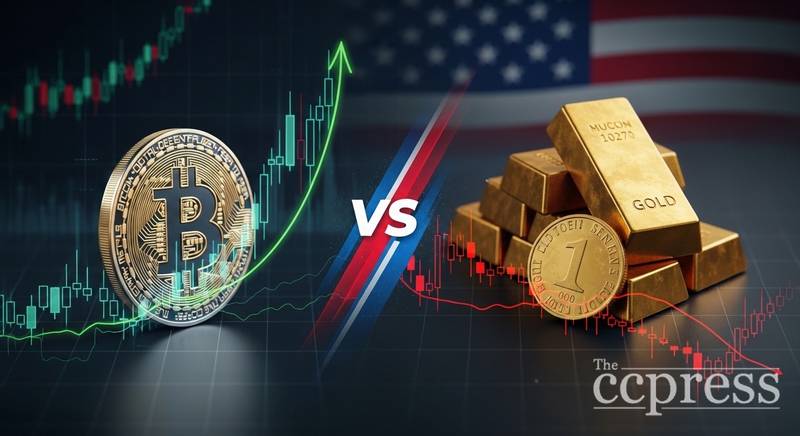
BTC vs Gold: Why Is Bitcoin Outperforming Gold Amid US-Iran Conflict?
Bitcoin is showing stronger momentum than gold as the U.S.-Iran conflict moves through its third week, challenging the usual assumption that traditional safe-haven assets automatically lead during geopolitical shocks. The conflict window in this article is anchored to late February 2026: the White House said President Trump authorized Operation Epic Fury in an announcement published on March 1, 2026, while a Defense Department fact sheet cited in the research trail placed the launch at 1:15 a.m. on February 28, 2026. That timeline matters because recent market reporting has measured Bitcoin and gold performance against that same period.1
According to the verified reporting available for this run, Bitcoin was up about 7% since the war's start as of March 11, 2026, while gold was roughly flat over the same window. By March 16, Barron's reported BTC at $73,687, up 3.1% in 24 hours and about 10% since February 28. Investor's Business Daily separately reported that Bitcoin had climbed above $74,000 and was up about 17% from its February 28 low. The evidence supports a narrower conclusion: Bitcoin has recently outperformed gold during the current U.S.-Iran conflict window, even if the exact spread still needs direct benchmark pricing to be fully verified.
Why Bitcoin Is Beating Gold During the US-Iran Conflict
The key story is not that gold suddenly stopped acting like a safe haven. It is that Bitcoin has recovered faster and attracted more momentum after the initial geopolitical shock. In past crises, investors often rushed first into gold, cash, or oil-linked trades. This time, BTC appears to have reclaimed attention once the first panic phase faded, while gold lost some of its early urgency.
That divergence is significant because both assets are often discussed as stores of value, but they trade differently in practice. Gold is still the older defensive asset, yet Bitcoin has become a global macro trade that reacts in real time across regions and exchanges. With BTC trading continuously and globally, it can absorb demand faster when investors want exposure outside traditional market hours. Fortune summarized that dynamic through market commentary from Gabe Selby, who said, “Crypto's 24/7 structure is increasingly an edge for the asset class.”
So the comparison is less about Bitcoin replacing gold overnight and more about how capital is behaving under stress. Gold has held its defensive reputation, but Bitcoin has delivered stronger upside during this specific conflict period. For traders, that makes the current BTC-vs-gold setup more than a headline contrast; it suggests that geopolitical hedging is broadening beyond legacy safe-haven assets.
What Is Driving Bitcoin's Outperformance Right Now
No single verified source proves exactly why Bitcoin is outperforming gold, so any causal explanation should stay cautious. Still, the available evidence points to a few market forces working together.
First, Bitcoin benefits from constant liquidity. Unlike many traditional products, BTC trades 24/7, which gives investors a way to reposition immediately when conflict headlines hit over a weekend or overnight. In an environment defined by uncertainty, that always-open market structure can matter as much as the asset's long-term narrative.
Second, Bitcoin continues to attract demand as a borderless macro asset. Gold remains the classic hedge, but BTC increasingly trades as a digital alternative for investors who want portability, deep global liquidity, and fast execution. That does not make it less volatile, but it does make it easier to access in a moment when capital is searching for flexible hedges.
Third, ETF-related demand and shifting store-of-value behavior appear to be part of the backdrop, even though this run did not verify fresh ETF flow figures directly. The research brief indicates that market coverage linked renewed Bitcoin strength to changing hedge behavior rather than to any new crypto-specific regulatory catalyst. In other words, this looks more like a macro and positioning story than a policy-driven rally.
That distinction is important. A weaker article would claim that war automatically makes Bitcoin rally. The evidence here does not support that. A more defensible reading is that Bitcoin initially sold off with broader risk assets, then rebounded sharply as traders rotated back into a liquid, globally accessible alternative store of value while gold flattened out.
What BTC vs Gold Signals for Crypto Markets Next
If Bitcoin keeps outperforming gold during a period of geopolitical stress, it strengthens the argument that BTC is maturing into a more credible crisis-era hedge, at least for part of the market. That would matter beyond Bitcoin itself. Sustained BTC leadership often improves broader crypto sentiment, especially when traders start reading Bitcoin strength as a sign of institutional confidence rather than just speculative appetite.
That does not mean the entire crypto market will move in a straight line. Sentiment in the surrounding market still appears mixed, and the research brief notes that fear has not fully disappeared from adjacent crypto coverage. Even so, Bitcoin showing resilience during a conflict-driven macro test is a useful signal. It suggests traders are not treating BTC purely as a high-beta risk asset.
In the short term, investors will likely watch whether Bitcoin can hold its gains if gold remains soft and broader markets stay uneven. If that relative strength persists, it could reinforce bullish positioning across the sector and spill into higher-risk names, similar to the kind of rotation traders often see when attention shifts from Bitcoin leadership into speculative segments such as meme coins. It could also support the broader narrative that large Bitcoin-focused buyers still matter for market structure, a theme already visible in coverage around major corporate accumulation plays.
For now, the cleanest takeaway is also the simplest one: during the current U.S.-Iran conflict window that began around February 28, 2026, Bitcoin has outperformed gold based on the available reporting. Why that is happening is partly interpretive, but the strongest explanations so far center on BTC's 24/7 liquidity, its growing role as a digital macro hedge, and a market increasingly willing to treat Bitcoin and gold as competing safe-haven trades rather than separate categories.
Sources: White House announcement on Operation Epic Fury.
Disclaimer: This article is for informational purposes only and does not constitute financial or investment advice. Cryptocurrency and digital asset markets carry significant risk. Always do your own research before making decisions.