



















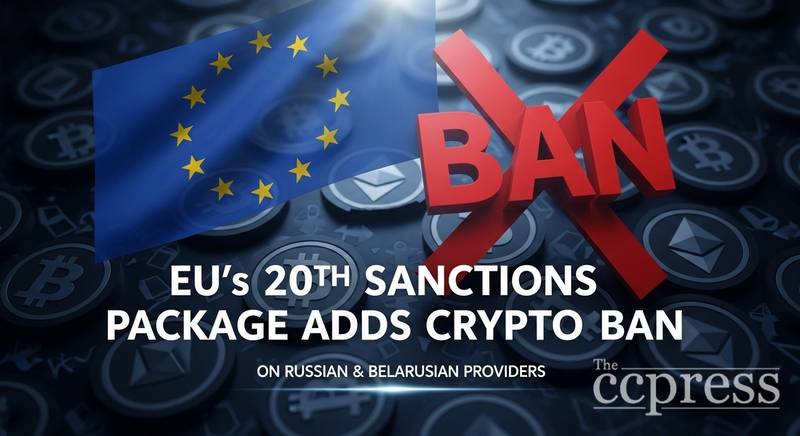
The European Union has adopted its 20th sanctions package against Russia, introducing a ban on crypto transactions with Russian and Belarusian providers as part of a broader crackdown on financial services linked to Moscow’s war effort.
What the EU’s 20th sanctions package changes for crypto transactions
The Council of the European Union announced on April 23 that the 20th round of sanctions targets energy, the military-industrial complex, trade, and financial services, with crypto explicitly included. The package prohibits EU persons and entities from conducting crypto asset transactions with providers based in Russia and Belarus.
The European Commission confirmed the adoption, framing the crypto restriction as part of a wider effort to close loopholes that have allowed sanctioned actors to move value through digital asset channels. The measure sits alongside restrictions on trade and energy that collectively tighten economic pressure on both countries.
The ban is a sanctions measure, not a market or technology regulation. It specifically targets the ability of Russian and Belarusian crypto providers to transact with EU counterparties, reinforcing the financial isolation strategy the EU has pursued since 2022.
Which crypto businesses and users could feel the immediate impact
In this context, “providers” refers to crypto asset service providers (CASPs), a category that includes exchanges, custodial wallet operators, brokers, and payment intermediaries that facilitate crypto transactions. Any CASP registered or operating primarily out of Russia or Belarus now falls under the ban.
For EU-based users, the practical effect means that transactions routed through Russian or Belarusian exchanges, OTC desks, or payment processors are now prohibited. Firms that maintain counterparty relationships with providers in either jurisdiction will need to sever or suspend those connections to remain compliant.
The distinction matters: the ban targets provider-level exposure, not general crypto usage. An EU resident holding Bitcoin or using a compliant European exchange is unaffected. The restriction applies specifically to transaction flows that involve a sanctioned-jurisdiction provider as a counterparty or intermediary.
This compliance pressure arrives as the crypto industry navigates tighter regulatory scrutiny globally. The recent wave of institutional Bitcoin ETF activity in the United States has underscored how regulated channels are becoming the dominant pathway for large-scale crypto transactions, a trend the EU sanctions reinforce by penalizing unregulated or sanctioned routes.
At the same time, reports that governments hold significant Bitcoin reserves illustrate how deeply digital assets are now embedded in sovereign financial strategy, making sanctions enforcement in crypto an increasingly high-stakes priority.
Why the move matters for Europe’s crypto compliance landscape
The inclusion of crypto in the 20th sanctions package signals that EU regulators view digital assets as a material sanctions-evasion risk. For compliance teams at European CASPs, the immediate task is reviewing counterparty lists and transaction monitoring rules to flag any exposure to Russian or Belarusian providers.
Cross-border transaction screening will need to account for indirect exposure as well. A transaction that passes through a non-EU intermediary before reaching a sanctioned provider could still create compliance risk for the originating EU entity. Firms serving European users or processing euro-denominated crypto flows will need to tighten due diligence on their full transaction chain.
The enforcement landscape also raises the stakes for individual users. As authorities increase scrutiny of crypto-linked financial crime, cases like the recent $1.24 million crypto scam losses in Hong Kong highlight the broader regulatory urgency around digital asset oversight and consumer protection.
For the European crypto industry, the 20th sanctions package reinforces that counterparty screening and jurisdictional risk assessment are now as critical in digital asset markets as they are in traditional banking. Providers that fail to adapt face not just regulatory penalties but exclusion from the EU’s rapidly formalizing crypto market structure.
Disclaimer: This article is for informational purposes only and does not constitute financial or investment advice. Cryptocurrency and digital asset markets carry significant risk. Always do your own research before making decisions.