
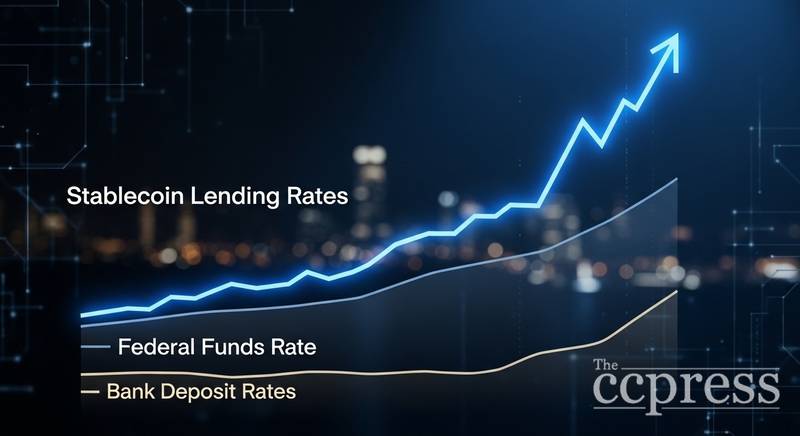
Stablecoin lending yields currently sit above traditional bank deposit rates but below the Federal Reserve’s policy benchmark, a spread that has fueled a regulatory battle over whether digital-asset platforms should be allowed to pass yield to users at all.
The Federal Open Market Committee held the federal funds target range at 3.5% to 3.75% at its March 18, 2026 meeting. That rate sets the cost of overnight interbank borrowing and serves as the benchmark against which virtually all dollar-denominated yields are measured.
Meanwhile, DeFi lending markets offer noticeably lower returns. Aave v3 on Ethereum currently pays roughly 2.71% on USDC, 2.36% on DAI, and 1.97% on USDT. Those APYs fluctuate with borrower demand and protocol utilization, meaning they have moved both above and below the Fed’s policy rate over different market cycles.
How Stablecoin Lending Rates Have Tracked the Fed Funds Rate
Stablecoin lending rates represent what borrowers on decentralized or centralized platforms pay to access dollar-pegged liquidity. Unlike the Fed funds rate, which is set by committee vote, these yields are determined by real-time supply and demand in lending pools.
The spread between the two is not fixed. When crypto-market leverage demand surges, stablecoin borrowing costs can spike well above the Fed benchmark. When risk appetite contracts, as current Aave data shows, yields compress below the policy rate. David Krause wrote on March 11, 2026 that Coinbase USDC rewards from January 2024 through January 2026 had a 98.7% correlation with Treasury yields, suggesting that stablecoin reward economics closely track macro rate conditions even when regulators attempt to restrict them.
“The GENIUS Act’s interest prohibition did not eliminate yield. It rerouted it.”
— David Krause, ProMarket
That dynamic is central to the current policy debate. If stablecoin yields persistently mirror Treasury returns, legislative bans on issuer-paid interest may simply push yield distribution to exchanges and affiliates rather than eliminating it.
Why Bank Deposit Rates Tell a Different Story
FDIC national deposit-rate data for March 2026 shows savings accounts paying 0.39%, interest checking at 0.07%, and money market accounts at 0.56%. Those figures sit far below both the Fed’s 3.5%-3.75% target range and current stablecoin lending APYs.
The gap exists because bank deposit rates are set through institutional pricing decisions, not open-market competition. Banks have limited incentive to raise deposit rates when loan demand, funding costs, and competitive pressure allow them to retain depositors at lower payouts. Stablecoin lending markets, by contrast, adjust in real time as borrower appetite shifts.
This transmission-speed difference is what makes the comparison politically charged. A saver earning 0.39% in an FDIC-insured account can see Aave’s 2.71% USDC rate and ask why the gap exists, even though the two products carry fundamentally different risk profiles. That question is now driving legislative action, much as broader concerns about AI-driven trading tools and new market infrastructure are reshaping how participants interact with digital assets.
The Regulatory Fight Over Yield Distribution
The House STABLE Act of 2025 addresses the gap directly. The bill states that “a permitted payment stablecoin issuer may not pay interest or yield to holders of its payment stablecoins,” an explicit prohibition on yield at the issuer level.
Banking groups want that prohibition extended further. The ICBA Federal Delegate Board wrote on March 4, 2026 that if yield-bearing payment stablecoins remain permitted through exchanges and affiliates, community-bank deposits could fall by $1.3 trillion and lending could contract by $850 billion.
“We urge your support for a robust and effective prohibition on the payment of interest, yield, rewards or similar inducements to stablecoin holders.”
— ICBA Federal Delegate Board, Senate letter
The ICBA’s $1.3 trillion deposit-loss estimate reflects the scale of concern. Community banks fund local lending through deposits; if those deposits migrate to stablecoin reward programs offering multiples of the national savings rate, the downstream effect on small-business and mortgage lending could be significant. Events like recent Bitcoin treasury selloffs illustrate how quickly capital can shift when yield incentives change.
What the Spread Signals for Market Participants
The current rate structure, with the Fed at 3.5%-3.75%, Aave USDC at 2.71%, and FDIC savings at 0.39%, reveals three distinct tiers of dollar yield. Each tier carries its own risk profile: insured deposits offer federal backing, stablecoin lending pools carry smart-contract and counterparty risk, and the Fed rate is an interbank benchmark unavailable to retail depositors directly.
Liquidity demand, borrower appetite, and platform competition drive stablecoin yields. When leverage demand in crypto markets rises, borrowing costs increase and lenders earn more. When markets cool, yields compress, as current Aave rates below the Fed benchmark demonstrate. Unlike scheduled token unlock events that follow fixed timelines, lending rate shifts are continuous and market-driven.
The regulatory outcome matters for both sides. If Congress closes the affiliate and exchange loopholes that the ICBA flagged, stablecoin reward programs could shrink, reducing competitive pressure on bank deposits. If the prohibition stays narrow, covering only issuer-level payments, the yield gap between stablecoin platforms and traditional savings accounts will likely persist as long as the Fed holds rates above deposit pricing.
The next concrete milestone is the STABLE Act’s progress through committee markup. Whether the final text extends the yield ban to intermediaries or keeps the narrow issuer-only scope will determine how much of the current rate spread survives regulation.
Disclaimer: This article is for informational purposes only and does not constitute financial or investment advice. Cryptocurrency and digital asset markets carry significant risk. Always do your own research before making decisions.