

$30 Billion Gone in One Hour: How the Flash Crash Unfolded
The flash wipeout was first flagged by the Coingraph News Telegram channel, which reported the $30 billion figure based on total market capitalization tracking. The speed of the move, compressed into a single hour, distinguishes it from the broader multi-day drawdowns that have characterized crypto markets throughout early 2026.
To put the figure in perspective, $30 billion represents a rapid contraction of roughly 1% or more of the total crypto market cap in just 60 minutes. While daily swings of this magnitude are not uncommon across a full trading session, the concentration into one hour points to a mechanical liquidation cascade rather than gradual organic selling.
The flash crash did not occur in a vacuum. A Bloomberg report from March 25 highlighted how recent crashes have rattled confidence across major exchanges, with Binance’s market dominance loosening as traders reassess counterparty risk. That backdrop of weakened confidence likely contributed to how quickly the sell-off spread.
Bitcoin was already trading in a sustained downtrend heading into the event, with BTC/USDT on Binance hovering in the low-to-mid $80,000 range after falling from highs above $100,000 earlier in the year.
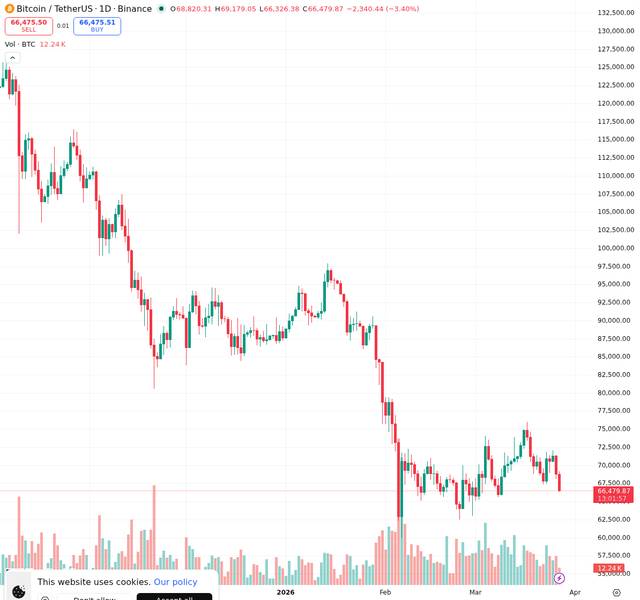
Bitcoin, Altcoins, and Liquidations: Who Got Hit Hardest
Derivatives data from CoinGlass shows that long liquidations have been a recurring feature of the 2026 downturn. The liquidation chart reveals that while the late-March activity did not match the extreme spikes seen in late January and early February, when single-day liquidations exceeded $2.5 billion, the pattern of long-biased forced closures persisted into late March.
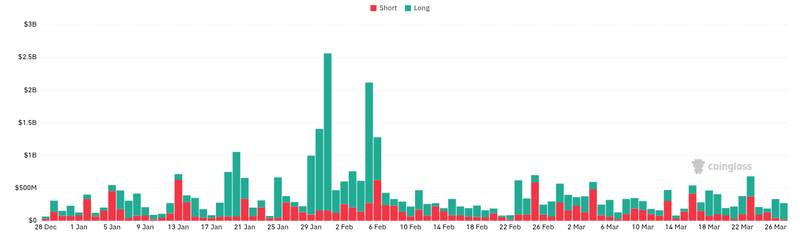
The dominance of long liquidations indicates that leveraged traders betting on price increases were repeatedly caught off-guard by downward moves. This mechanical unwinding of long positions accelerates sell-offs as forced liquidations push prices lower, triggering further margin calls in a cascade effect.
Earlier in 2026, a Federal Reserve rate shock contributed to a broader $100 billion drawdown across Bitcoin, Ethereum, and altcoins. That episode demonstrated how macro catalysts can trigger outsized moves when the derivatives market is heavily positioned in one direction.
What Traders Are Watching After the Flash Wipeout
This $30 billion hourly wipeout arrived in a market already under pressure. BTC, ETH, and SOL spot ETFs all posted net outflows on March 26, suggesting institutional appetite had cooled ahead of the flash event.
Options markets also added to the volatility backdrop. $15 billion in Bitcoin, Ethereum, XRP, and Solana options expired this week, a setup that historically amplifies short-term price swings as market makers adjust hedges.
The compressed nature of the loss, $30 billion in 60 minutes, underscores how thin liquidity conditions and high leverage can magnify moves in crypto markets. Traders are now watching whether Bitcoin can hold current support levels near the low $80,000s or whether the flush triggers a deeper leg down.
With institutional flows turning negative and derivatives markets still showing elevated long exposure, the conditions that produced this flash crash have some traders rotating into alternative assets until the dust settles. Whether this was a one-off liquidity event or the start of a larger move will depend on incoming macro data and how quickly open interest rebuilds.
Disclaimer: This article is for informational purposes only and does not constitute financial or investment advice. Cryptocurrency and digital asset markets carry significant risk. Always do your own research before making decisions.


