



















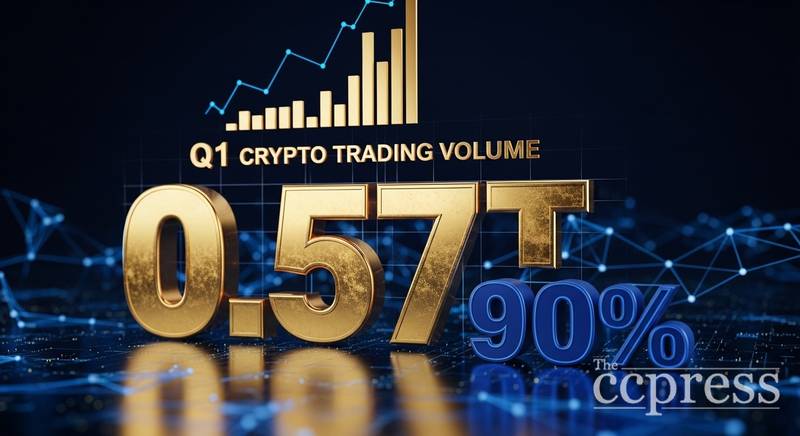
CoinGlass reports that overall crypto trading volume reached approximately $20.57 trillion in Q1 2026, with derivatives contracts accounting for roughly 90% of that total. The figures paint a quarter defined not by retail spot buying, but by leveraged positioning across futures and perpetual swap markets.
CoinGlass Says Q1 Crypto Trading Volume Reached $20.57 Trillion
The Q1 data, published in CoinGlass’ quarterly market share report, breaks the $20.57 trillion total into roughly $1.94 trillion of spot volume and $18.63 trillion of derivatives volume. That puts the derivatives-to-spot ratio at approximately 9.6x for the quarter.
January was the strongest month of the quarter, generating about $704.7 billion in spot volume and $6.73 trillion in derivatives volume. Activity declined through February and into March, which recorded the quarterly low.
The pattern mirrors a broader cooldown visible in current market conditions. Total crypto market capitalization sits near $2.38 trillion, with Bitcoin dominance above 56%, suggesting capital has consolidated into the largest asset rather than spreading across altcoins.
Derivatives Took 90% of Q1 Activity
Using CoinGlass’ own figures, derivatives accounted for about 90.57% of all crypto trading volume in Q1. Spot markets, by contrast, represented less than 10% of total activity.
That split matters because it reveals how traders engaged with crypto markets during Q1. A derivatives-heavy quarter signals that activity was concentrated in leveraged products, perpetual swaps, and futures contracts rather than outright asset purchases.
Among exchanges, Binance processed approximately $4.9 trillion in Q1 derivatives volume, maintaining its position as the dominant venue. Hyperliquid, a decentralized perpetuals platform, reached about $492.7 billion in derivatives volume, enough to enter the top 10 derivatives venues for the first time.
Hyperliquid’s rise into the top tier is notable given the broader questions around decentralized exchange volume and transparency. The platform’s growth occurred during a quarter when the XRP Ledger treasury valuation debate and scrutiny of stablecoin compliance standards kept market-structure issues in focus.
What the Q1 Volume Mix Signals for the Crypto Market
CoinGlass characterized Q1 as a period of structural adjustment rather than euphoria, noting that the quarter “was not about euphoria” but rather “about recovery, concentration, and shifting market structure.”
“Q1 was not about euphoria. It was about recovery, concentration, and shifting market structure.”
— CoinGlass
The January-to-March volume decline supports that framing. Traders were most active early in the quarter, then pulled back as macro uncertainty weighed on positioning. The Fear and Greed Index currently reads 9, deep in “Extreme Fear” territory, with Bitcoin trading near $66,926, roughly flat over the past 24 hours.
A quarter where nine out of every ten dollars traded flowed through derivatives rather than spot markets suggests participants were hedging, speculating on short-term moves, or managing existing leverage, not accumulating assets outright. That behavior is consistent with the risk-off tone reflected in the recent U.S. jobs data and broader macro backdrop.
CoinGlass identified the Federal Reserve’s rate path, Bitcoin spot ETF flows, and ongoing regulatory framework implementation across major jurisdictions as the primary watchpoints heading into Q2. Whether derivatives continue to dominate at a 9.6x ratio or spot activity recovers will depend largely on how those macro catalysts resolve.
Disclaimer: This article is for informational purposes only and does not constitute financial or investment advice. Cryptocurrency and digital asset markets carry significant risk. Always do your own research before making decisions.