




















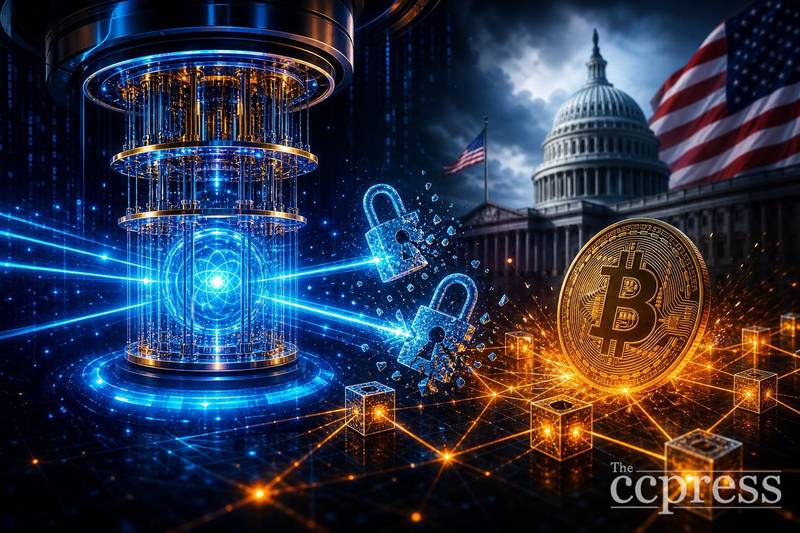
The U.S. government has reportedly committed $2 billion to quantum computing development, reigniting debate over whether advancing quantum technology could eventually pose a threat to Bitcoin’s cryptographic foundations.
The investment, reported by Axios, signals that Washington views quantum computing as a strategic priority. While private-sector firms like IBM and Google have poured resources into quantum research for years, a multibillion-dollar federal commitment carries different implications for timelines and scale.
Government-backed programs tend to accelerate applied research in ways that corporate R&D alone cannot. Defense and intelligence applications often drive breakthroughs that later cascade into civilian technology, and quantum computing fits squarely into that pattern.
For the cryptocurrency sector, the significance is straightforward: quantum computing is the most frequently cited long-term threat to blockchain security. A state-level investment of this size moves the conversation from abstract theory toward concrete infrastructure planning.
Why quantum progress raises specific concerns for Bitcoin
Bitcoin’s security rests on two cryptographic pillars: the SHA-256 hashing algorithm used in mining and the Elliptic Curve Digital Signature Algorithm (ECDSA) used to protect private keys. Both were designed to be computationally infeasible to break with classical computers.
A sufficiently powerful quantum computer running Shor’s algorithm could, in theory, derive a private key from a public key. This is the scenario that fuels “quantum threat” discussions, and it is why NIST’s post-quantum cryptography standardization work has drawn attention from Bitcoin developers and policymakers alike.
No quantum computer today comes close to the qubit count or error-correction capability needed to threaten Bitcoin’s cryptography. Current estimates from researchers suggest that timeline is still years, possibly decades, away.
The phrase “growing threat concerns” reflects an evolving risk calculus, not an imminent emergency. The federal investment matters because it compresses uncertainty about when quantum capability might reach meaningful thresholds.
What Bitcoin developers, investors, and policymakers will watch next
For Bitcoin developers, the focus will remain on post-quantum migration planning. Several proposals for quantum-resistant signature schemes have circulated in Bitcoin development forums, though none have reached consensus for implementation.
Investors watching this space should track NIST’s ongoing post-quantum standards work, which sets the benchmark that both government and private systems will eventually adopt. If Bitcoin’s protocol were to lag behind federal cryptographic standards, that gap could become a regulatory talking point, similar to how state-level enforcement actions against crypto businesses have intensified around consumer protection concerns.
Policymakers face a dual challenge: advancing quantum capability for national security while managing downstream risks to financial infrastructure that relies on classical cryptography. Bitcoin is not the only system exposed, but its decentralized governance makes coordinated upgrades harder than in centralized systems.
The broader crypto ecosystem is already navigating overlapping infrastructure concerns. Exchanges like Binance have faced temporary network disruptions tied to protocol upgrades, underscoring how even routine technical transitions require careful coordination. Meanwhile, platforms continue to expand into new financial products, raising additional questions about how quantum-era security standards would apply across increasingly complex crypto infrastructure.
The reported $2 billion quantum investment does not make Bitcoin insecure today. It does shorten the window in which the Bitcoin community can treat post-quantum migration as a distant, theoretical exercise.
Disclaimer: This article is for informational purposes only and does not constitute financial or investment advice. Cryptocurrency and digital asset markets carry significant risk. Always do your own research before making decisions.