



















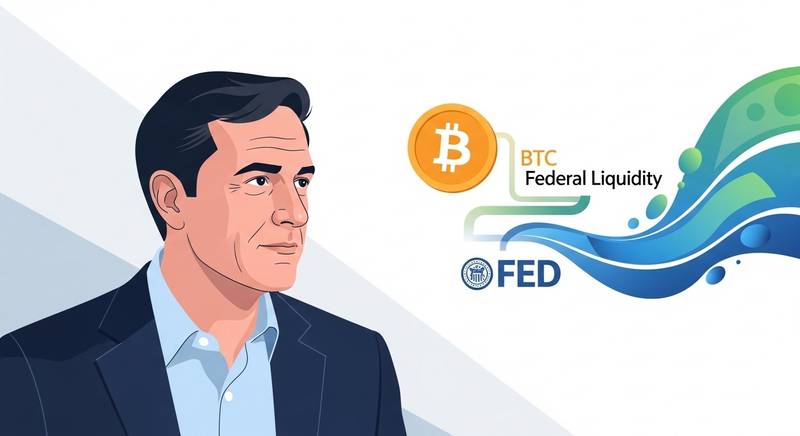
Arthur Hayes is not calling for a quick Bitcoin breakout. His argument is harsher: the market probably stays stuck until Federal Reserve liquidity returns and the banking system gets relief. That is an opinion thesis, not a verified policy roadmap, but the Fed’s own data shows why the idea has traction.
Arthur Hayes’ Core Argument on BTC and Fed Liquidity
Cointelegraph reported that Hayes said he would rather wait than make a bet on Bitcoin amid geopolitical tension, and that the turning point for him is when the Fed starts printing money again. The report tied those comments to a recent Coin Stories interview published on YouTube.
“I wouldn’t invest $1 in Bitcoin right now.”
Arthur Hayes via Cointelegraph
The sharper headline version, that BTC cannot meaningfully rise until the Fed injects liquidity specifically to plug bank balance-sheet holes, comes from a single unconfirmed report and should be treated as a paraphrase rather than a documented verbatim Hayes quote. What is verified is narrower: Hayes is waiting for monetary easing, not chasing a near-term rally.
The research brief put Bitcoin at $74,668, which gives his caution a live market anchor instead of a theoretical one.
That framing also matches the site’s broader internal read on the setup: Arthur Hayes Says Bitcoin Rally May Wait for Fed Liquidity Injection treated a policy pivot, not a crypto-only catalyst, as the real trigger traders are waiting for.
Why Bank Balance Sheet Stress Matters for Bitcoin in This Thesis
The Fed’s Spring 2025 Financial Stability Report said fair-value losses on fixed-rate assets were still sizable for some banks and remained sensitive to interest-rate changes, and at the end of 2024 banks’ available-for-sale portfolios were $182 billion below book value while held-to-maturity portfolios were $297 billion below book value. Those $182 billion and $297 billion gaps are the cleanest official evidence behind the balance-sheet stress Hayes is implicitly pointing to.
The Fed’s February 2025 Monetary Policy Report also said reserve balances had edged down by $68 billion since late June 2024 to around $3.2 trillion. The same February 2025 report said the FOMC intends to stop shrinking securities holdings when reserves are somewhat above the level judged consistent with ample reserves.
That matters because Hayes’ causal chain runs through those same official data points: the bank portfolio gaps of $182 billion and $297 billion sit beside reserve balances near $3.2 trillion, a backdrop that still looks like liquidity management rather than overt easing. Even steady demand stories like Corporate Bitcoin Holdings Hit Record in 2026 do not invalidate that macro argument on their own.
What Would Need to Change Before BTC Could Break Higher
Under Hayes’ framework, the first signal is a Fed shift from runoff toward fresh liquidity support. The data he appears to be leaning on are the $3.2 trillion reserve backdrop and the bank portfolio gaps of $182 billion and $297 billion, not a crypto-native momentum story.
That is also why token-specific catalysts can look busy while the $3.2 trillion reserve backdrop and the banking gaps of $182 billion and $297 billion still frame the bigger macro debate. A supply-side story like BNB Chain Burns 1.57M BNB in 35th Quarterly Token Burn may matter for BNB, but Hayes’ Bitcoin view still turns on dollar liquidity and banking-system repair.
The hard limit on the thesis is just as important as the headline: the February 2025 Monetary Policy Report discusses reserve balances and runoff, and the Spring 2025 Financial Stability Report documents the losses, but neither document says the Fed is preparing liquidity specifically to plug bank balance-sheet holes. That part remains inference layered on top of official data, not an announced policy plan.
If reserve conditions improve and those $182 billion and $297 billion valuation gaps shrink, Bitcoin could finally get the macro backdrop Hayes wants. If they do not, his message is blunt: patience before upside.
Disclaimer: This article is for informational purposes only and does not constitute financial or investment advice. Cryptocurrency and digital asset markets carry significant risk. Always do your own research before making decisions.