


















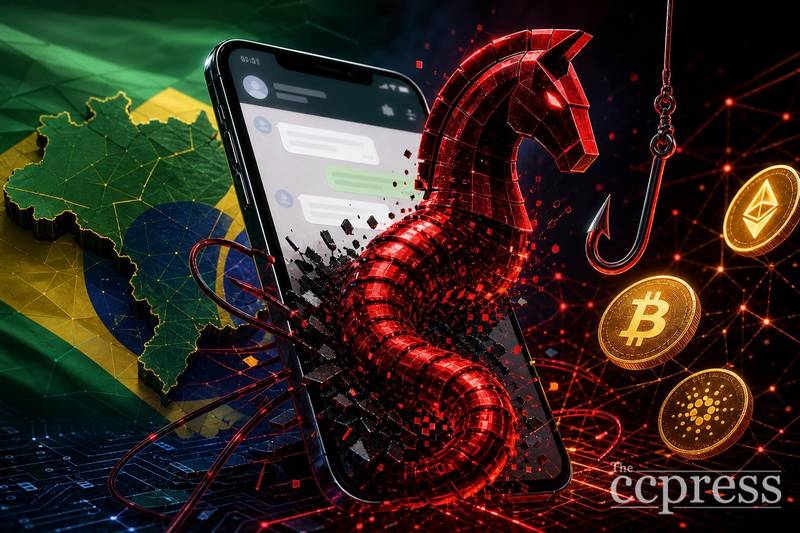
A Brazilian banking trojan is reportedly hijacking WhatsApp accounts to distribute crypto phishing messages to victims’ contacts, according to security researchers who have documented the malware’s self-spreading capabilities.
What the Report Says About the Brazilian Trojan
Security firm Elastic documented the trojan, tracked as TCLBanker, in a detailed technical report identifying it as a Brazilian-origin banking malware. The trojan reportedly takes control of WhatsApp on infected devices and uses the compromised accounts to send phishing lures to the victim’s contact list.
Separate reporting from BleepingComputer confirmed the malware’s self-spreading behavior over both WhatsApp and Outlook, noting that the technique allows the trojan to propagate rapidly through trusted communication channels.
The malware’s use of WhatsApp as a distribution vector is particularly relevant to cryptocurrency holders. Messages arriving from known contacts carry inherent trust, making recipients far more likely to click links or follow instructions than they would from unknown senders.
How Hijacked WhatsApp Accounts Fuel Crypto Phishing
When a trojan controls a victim’s WhatsApp account, every message it sends appears to come from a real person the recipient knows. This trust relationship is the core of the attack’s effectiveness for crypto-targeted phishing.
Phishing messages sent through compromised accounts can direct targets to fake exchange login pages, fraudulent wallet connection prompts, or requests for seed phrases. Because the message arrives from a friend or family member, the usual skepticism that protects users from cold phishing attempts is significantly reduced.
WhatsApp’s end-to-end encryption, while protecting message content from server-side interception, does not protect users from client-side attacks where malware has already compromised the device. The encryption becomes irrelevant once an attacker controls the application itself.
The risk extends beyond individual wallets. As institutional products like BlackRock’s tokenized money-market funds bring more participants into the digital asset space, phishing campaigns that exploit trusted channels pose a threat to a widening pool of crypto holders.
Why the Threat Matters for Crypto Users
The combination of trusted messaging channels and cryptocurrency’s irreversible transactions creates an especially dangerous pairing. Unlike traditional banking fraud, stolen crypto funds generally cannot be recovered or reversed by a financial institution.
Users should treat any unexpected message requesting wallet interactions, urgent payments, or credential entry with suspicion, even when it arrives from a known contact. Verifying requests through a separate communication channel remains one of the most effective defenses against trust-based phishing.
The growing sophistication of social engineering attacks also highlights why clear regulatory frameworks for crypto increasingly need to account for consumer protection beyond exchange-level controls. Security awareness at the individual level remains critical, particularly as activity picks up across ecosystems where Ethereum and rival chains compete for DEX volume.
Disclaimer: This article is for informational purposes only and does not constitute financial or investment advice. Cryptocurrency and digital asset markets carry significant risk. Always do your own research before making decisions.