


















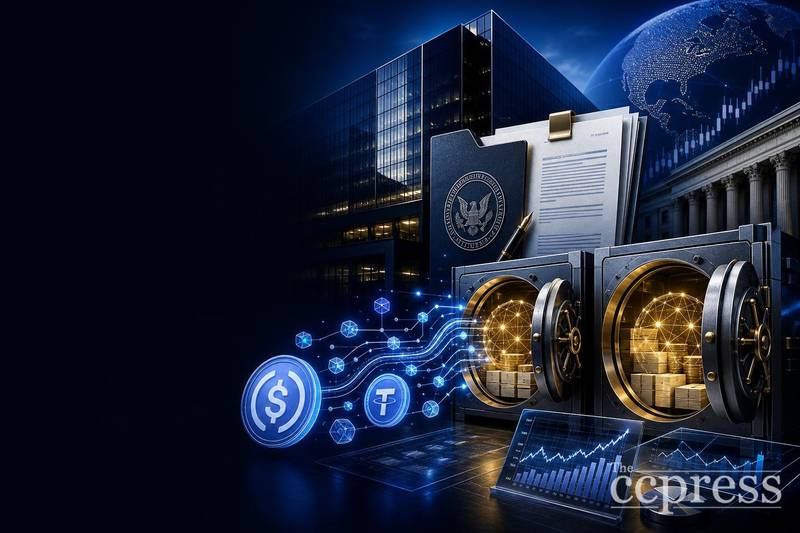
BlackRock has filed documents with the U.S. Securities and Exchange Commission that indicate plans to launch two tokenized money-market funds designed for stablecoin holders, signaling a deeper push by the world’s largest asset manager into blockchain-based financial products.
What the SEC filing reveals
The disclosure appears in a 497K filing posted to the SEC’s EDGAR database, which is typically used to update prospectus materials for existing fund families. The filing points to two separate tokenized money-market fund products, though it represents a regulatory indication of intent rather than confirmation of a live product launch.
BlackRock has already moved into tokenized fund structures through its Treasury Trust fund, which offers DLT (distributed ledger technology) shares that settle on blockchain infrastructure. The new filing suggests the firm is expanding that approach with products explicitly aimed at holders of stablecoins.
The distinction between an SEC filing and a finalized product matters. A 497K supplement updates fund documentation but does not guarantee a launch date or confirm that shares are available for purchase. Investors should treat this as a directional signal, not a done deal.
Why stablecoin holders are the target audience
Stablecoin holders collectively sit on tens of billions of dollars in assets that, by design, generate no yield. A tokenized money-market fund offers a path to earn returns on idle capital without leaving blockchain rails.
Money-market funds invest in short-duration, low-risk instruments like Treasury bills and commercial paper. Tokenizing those funds means stablecoin holders could move between cash-equivalent positions and yield-bearing products on-chain, reducing friction compared to off-ramping into traditional finance accounts.
The practical appeal depends on product structure and access terms. Key questions remain: which blockchains will support the funds, whether minimum investment thresholds will apply, and how redemptions will work. Recent Ethereum ecosystem developments suggest that on-chain financial products increasingly compete on settlement speed and composability.
For institutional stablecoin holders managing treasury operations, the calculus is straightforward. Parking capital in a BlackRock money-market fund on-chain could offer both yield and the credibility of a regulated fund manager, a combination that purely crypto-native yield products have struggled to match.
What this signals for tokenized finance
BlackRock manages over $10 trillion in assets. When a firm of that scale files SEC paperwork for tokenized products, it validates the category in a way that smaller issuers cannot. This is not an experimental pilot from a crypto startup; it is a mainstream asset manager building tokenized products within existing regulatory frameworks.
The filing fits a broader pattern of institutional adoption of tokenized real-world assets. Traditional finance firms have been exploring on-chain versions of bonds, money-market instruments, and credit products throughout 2025 and into 2026. BlackRock’s move could accelerate that trend by setting a competitive benchmark.
Regulatory clarity will shape how quickly these products reach market. Ongoing legislative efforts around crypto innovation in the U.S. and debates over stablecoin regulation will influence both the demand side and the compliance requirements for tokenized fund issuers.
The next milestones to watch are any follow-up SEC filings that specify fund terms, blockchain infrastructure partners, and target launch dates. Until those details emerge, BlackRock’s filing stands as the strongest institutional signal yet that tokenized money-market products are moving from concept to regulatory pipeline.
Additional source references: source document 1.
Disclaimer: This article is for informational purposes only and does not constitute financial or investment advice. Cryptocurrency and digital asset markets carry significant risk. Always do your own research before making decisions.