
These rules already apply, but “MiCA-compliant” is not a complete product verdict. A reader must verify the issuer, white paper, reserve structure, direct-redemption right, supervising authority, and services offered by each platform. A stable secondary-market price cannot replace that evidence.

Key takeaways
- EMT issuers must be credit institutions or electronic-money institutions, while most ART issuers need separate authorisation from their home-state authority.
- ART capital starts at the highest of EUR350,000, 2% of average reserves, or one quarter of prior-year fixed overheads; reserves and redemption remain separate obligations.
- Since 2 March 2026, some CASPs transferring or holding EMTs as payment services also need PSD2 permission or a qualifying payment-provider arrangement.
MiCA stablecoin rules already apply across the EU
MiCA Titles III and IV became applicable on 30 June 2024, six months before the broader regime applied on 30 December 2024. The stablecoin framework is therefore not waiting for a future EU deadline. Remaining questions concern the exact issuer, service, national supervision, and technical standards.
ESMA’s guidance for non-compliant ARTs and EMTs instructed national authorities to address affected services by the end of the first quarter of 2025. Trading venues were expected to stop making those tokens available for acquisition, while sell-only access could support an orderly exit. Mere custody or transfer did not automatically become illegal.
This distinction matters for USDT. A European user may still control USDT in a private wallet, yet a regulated venue can restrict buying, pairs, deposits, or conversion routes. The applicable result depends on the service and issuer status, not a claim that the token itself was universally banned.
ART and EMT classification determines the issuer route
An EMT maintains stable value by referencing one official currency, such as the euro or US dollar. An ART references another value or right, including a basket of currencies, commodities, crypto-assets, or a combination. An algorithmic label does not create a third stablecoin category; the token still needs a functional MiCA classification.
| Requirement | Asset-referenced token | E-money token |
|---|---|---|
| Reference | Value, right, basket, commodity, crypto-asset, or combination | One official currency |
| Eligible issuer | EU legal person authorised under MiCA, or a qualifying credit institution | Credit institution or electronic-money institution |
| White paper | NCA approval before public offer or trading admission | Notification to the authority before publication |
| Own funds | Highest of EUR350,000, 2% of average reserve, or 25% of fixed overheads | E-money prudential requirements plus MiCA obligations |
| Reserve | Segregated reserve, qualified custody, prudent investment, and reconciliation | Funds safeguarded under the e-money framework and MiCA Article 54 |
| Redemption | Permanent right under the ART terms and reference mechanism | At any time and at par in the referenced currency, without a redemption fee |
| Significant-token supervision | EBA direct supervision | EBA and home authority, depending on issuer type |
The table is a classification and obligation map, not a shortcut for legal analysis. A tokenised security, deposit token, fund share, or derivative may fall outside MiCA’s ART and EMT regimes. The legal rights and issuer structure must be read before applying a stablecoin label.
Authorisation requires capital and an operating file
An ordinary ART issuer needs home-state authorisation before offering the token publicly or seeking admission to trading. Its application covers governance, management suitability, business model, reserve policy, custody, complaints, business continuity, conflicts, redemption, technology, and a legal opinion supporting the proposed classification.
Credit institutions use a modified ART route, but they still notify their authority and submit the required white paper and operating information. For EMTs, the issuer must already be a credit institution or electronic-money institution. There is no standalone EMT licence for an otherwise unregulated software company.
ART own-funds requirements use the highest of three measurements: EUR350,000, 2% of the six-month average reserve, or one quarter of the preceding year’s fixed overheads. The competent authority can require an additional buffer after evaluating reserve quality, market importance, transaction activity, controls, and stress results.
For an ART with EUR100 million in average reserves, the 2% calculation produces EUR2 million before any supervisory uplift. That capital sits above the reserve; it cannot be counted as the assets backing token holders. Significant ART status increases the prudential burden further.
Reserves must survive redemption stress
A reserve is credible only when its composition, segregation, custody, maturity, concentration, valuation, and reconciliation support the promised exit. “Fully backed” states a nominal relationship but does not show whether the issuer can obtain cash promptly during a bank failure, market shock, or concentrated redemption wave.
ART reserve assets must be legally and operationally segregated from the issuer’s estate. Eligible third-party custodians depend on the asset type, and reserve investments must remain highly liquid with minimal market, credit, and concentration risk. The issuer remains responsible for maintaining access to assets needed for redemption.
For funds received in exchange for EMTs, at least 30% must be placed in separate credit-institution accounts. The remainder is invested in secure, low-risk, highly liquid instruments denominated in the referenced currency. The deposit floor rises to 60% where the significant-token rules apply.
Bank deposits are liquid but create bank-counterparty concentration; securities can diversify banks but add market and settlement risk. A useful reserve review therefore records the asset mix, custodian allocation, maturity buckets, valuation date, outstanding supply, and liquidity available within one and five working days.
Recovery and redemption plans address different failures. A recovery plan explains how the issuer restores compliance during stress, while the MiCA redemption plan governs orderly repayment when authorities determine that redemption must proceed. Both require operational responsibilities, communication, asset-sale sequencing, and equitable treatment of holders.
Redemption rights are stronger than a market peg
An EMT holder has a claim against the issuer and must be able to redeem at any time and at par in funds denominated in the referenced currency. Issuance occurs at par when the issuer receives funds. MiCA prohibits the issuer from charging a redemption fee, although intermediaries may have separately disclosed service charges.
An ART holder also receives a permanent redemption right, but the settlement reflects the referenced assets and terms of that ART. The issuer must disclose valuation, timing, conditions, and any permitted fee. Basket composition can make the operational exit more complex than redeeming a single-currency EMT.
Direct redemption differs from selling on an exchange. A venue can provide immediate liquidity but expose the user to spread, depth, fees, and platform controls. Issuer redemption invokes legal holder rights but can require eligibility checks, banking details, minimum operational steps, and settlement time.
MiCA also prohibits interest linked to the period for which a holder keeps an ART or EMT. A reward cannot be assessed from its product name alone. The payer, funding source, required activity, holding period, and economic equivalence to interest all matter.
Real EMT records make the framework concrete
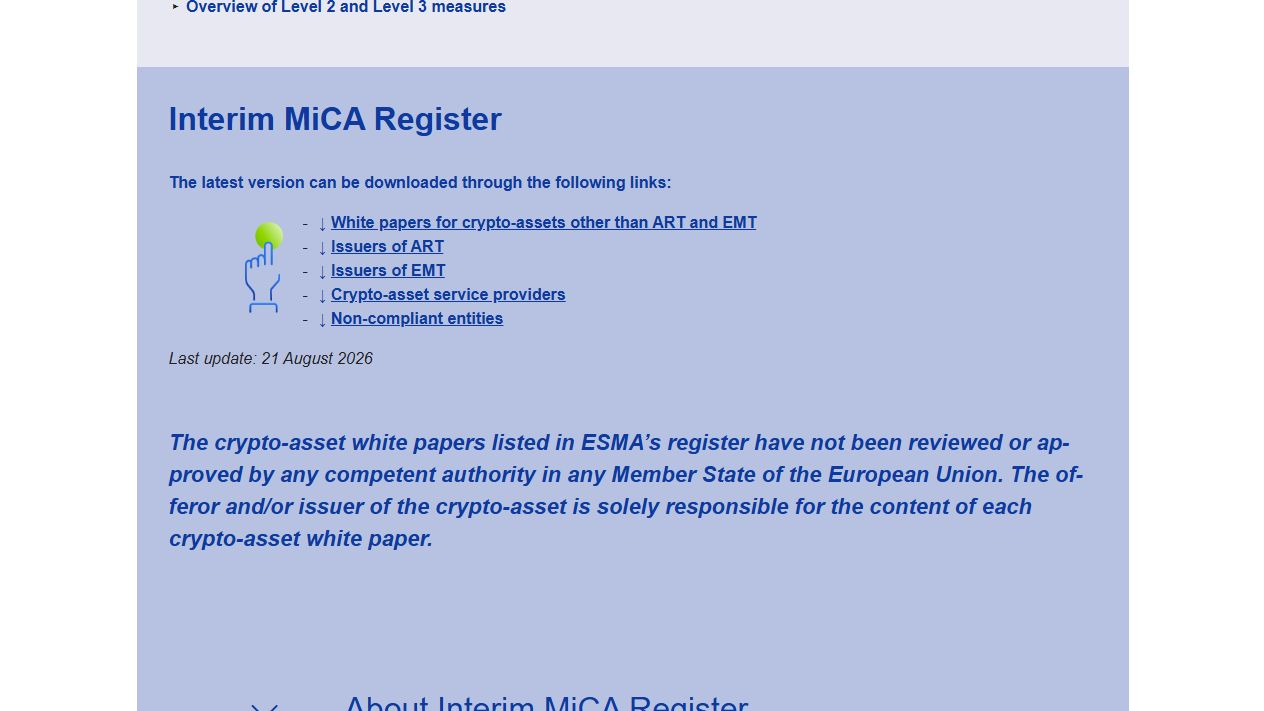
The ESMA interim register dated 21 August 2026 contained 50 EMT white-paper rows, including multiple versions or tokens from the same issuer. A register row identifies submitted issuer and white-paper data; ESMA expressly warns that competent authorities have not reviewed or approved every statement inside those white papers.
| EMT | Issuer in ESMA register | Home state and issuer status | White-paper notification |
|---|---|---|---|
| USDC | Circle Internet Financial Europe SAS | France, electronic-money institution | 1 July 2024 |
| EURC | Circle Internet Financial Europe SAS | France, electronic-money institution | 1 July 2024 |
| EURCV | Société Générale-FORGE | France, electronic-money institution | 1 July 2024 |
| EURI | Banking Circle S.A. | Luxembourg, credit institution | 28 August 2024 |
| USDG | Paxos Issuance Europe Oy | Finland, electronic-money institution | 19 December 2025 |
The table does not rank the tokens. It establishes issuer identity, jurisdiction, regulatory status, and a dated white-paper record. A comparison still needs the token contract, supported networks, reserve report, direct-redemption eligibility, settlement route, circulating supply, and current venue access.
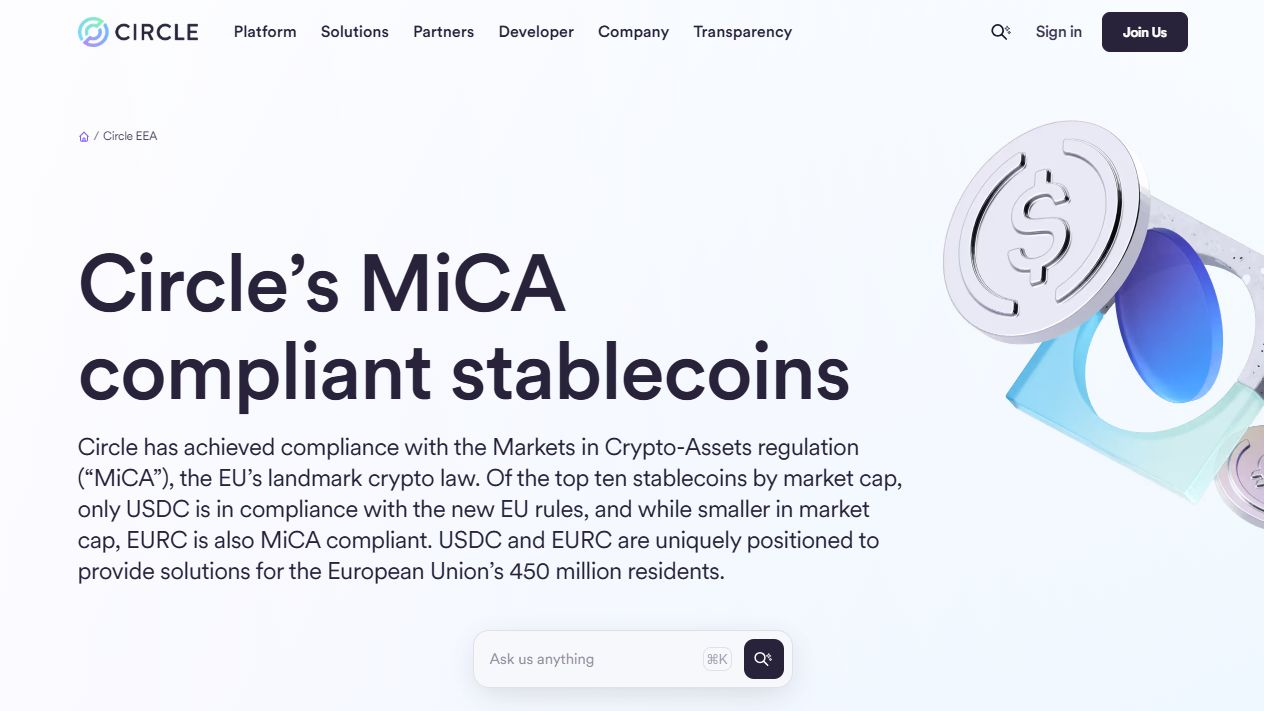
Circle reported USDC circulation of USD73.3 billion and total reserves of USD73.6 billion on 31 August 2026. It also reported USD10.2 billion issued and USD10.5 billion redeemed over seven days. These issuer-published figures show scale and turnover, but they do not replace independent verification of reserve composition or holder eligibility.
USDC and EURC share an issuer but reference different currencies and can have different networks, market depth, banking routes, and use cases. The comparison must keep the token, contract, currency, and redemption account aligned rather than transferring evidence from one Circle product to another.
CASP distribution and PSD2 permission are separate
- A CASP may custody, exchange, transfer, place, or distribute a stablecoin without being the reserve issuer. Its MiCA authorisation establishes the services it may perform, not the accuracy of every issuer disclosure or an unconditional right for every customer to redeem directly with the issuer.
- The overlap became more operational in 2026. The EBA transition for PSD2 and MiCA ended on 2 March. A CASP transferring EMTs on behalf of clients, or operating qualifying custodial-wallet payment services, may need payment-service authorisation or to act through an authorised payment-service provider.
- Exchange of crypto-assets for funds or other crypto-assets is not automatically treated as a PSD2 payment service under that EBA approach. The regulated boundary instead turns on the actual EMT transfer, custody, payment-account function, and party executing the payment service.
- A product review should trace issuance, custody, exchange, transfer, redemption, and fiat settlement separately. TheCCPress’s explanation of when MiCA became fully applicable provides the wider CASP context, while this stablecoin analysis focuses on the issuer and EMT payment layers.
Payment caps and significant supervision limit scale
MiCA restricts ARTs used widely as a means of exchange within a single currency area. If quarterly daily averages exceed both one million transactions and EUR200 million, the issuer must stop issuance and submit a remediation plan within 40 working days. The authority must approve issuance before it resumes.
The same mechanism extends to EMTs denominated in a currency that is not official in an EU member state. It targets payment use rather than investment or exchange activity, so transaction classification matters. Reporting must separate transfers used for settlement from trades and other excluded activity.
The EBA, whose role can be compared with other authorities in the 2026 crypto regulator watchlist, assesses significance using at least three statutory criteria. Indicators include 10 million holders, EUR5 billion in value or reserves, or 2.5 million daily transactions worth EUR500 million. Cross-border importance and interconnectedness also count.
Significant ART issuers move into direct EBA supervision. Significant EMTs can involve EBA and home-authority supervision, particularly where an electronic-money institution issues the token. Higher own funds, liquidity management, stress testing, recovery planning, and reporting follow scale; market capitalisation alone does not establish significance.
Verification begins with the issuer and exit route
- Start with the token’s legal name, contract, issuer, reference currency, and home authority. Match those fields against the ESMA register and issuer white paper, then record reserve date, supply date, custody allocation, supported networks, redemption eligibility, timing, fees, and the CASP handling the transaction.
- Treat the register as a regulatory record, not an endorsement. ESMA states that the issuer or offeror remains responsible for white-paper content. Check reserve numbers against a dated assurance or issuer report without combining supply and reserve values from different dates.
- Account for the gap between legal status and real access. In an EU holder’s discussion about converting a large USDT balance reviewed on 10 August 2026, the user retained non-custodial control but struggled to find a European venue offering the required conversion and fiat exit after listing restrictions.
- Read that account as evidence of one holder’s access friction, not a universal USDT ban or proof that an offshore exchange is suitable. The wallet controlled custody, each venue controlled listing and liquidity, the bank controlled fiat receipt, and the issuer remained responsible for its own redemption terms.
- Price the complete exit before moving funds. Confirm the exact contract, authorised venue, available pair, executable spread, withdrawal network, direct-redemption eligibility, bank route, limits, and settlement time. Complete a low-value round trip before relying on the route for a material balance.
- Apply the same discipline across jurisdictions. The Hong Kong stablecoin ordinance and Singapore stablecoin framework use familiar terms such as reserve and redemption, but their categories, permissions, and supervisory allocation do not automatically match MiCA.
Conclusion
MiCA stablecoin compliance in 2026 begins with the ART or EMT classification and the authorised issuer. It continues through capital, reserve segregation, custody, liquidity, white-paper disclosure, redemption, and significant-token supervision. A register entry confirms the regulatory record, but it does not rank the token or guarantee every disclosure.
For users, the decisive test is whether the exact token can be acquired, transferred, and converted through an authorised route at an acceptable total cost. For issuers and CASPs, the decisive test is whether each entity holds the permission required for issuance, custody, trading, transfer, payment, and redemption rather than relying on one MiCA label.
Frequently asked questions
Are all euro stablecoins EMTs under MiCA?
No. A token referencing one official currency generally fits the EMT definition, but deposits, financial instruments, and other excluded products require separate classification. Verify the legal rights, issuer, and authority record rather than relying on the euro peg alone.
Does MiCA guarantee one-to-one stablecoin backing?
No. MiCA imposes reserve, safeguarding, custody, liquidity, and redemption requirements, but compliance is not a guarantee against bank, operational, market, cyber, or fraud risk. Review the dated reserve evidence and the executable exit route.
Can a MiCA-authorised CASP redeem every stablecoin?
No. A CASP may provide custody, exchange, or transfer services without being the issuer or direct-redemption agent. Check the issuer’s holder eligibility and settlement policy separately from the platform’s trading and withdrawal terms.
Disclaimer: This article is for informational purposes only and does not constitute financial or investment advice. Cryptocurrency and digital asset markets carry significant risk. Always do your own research before making decisions.