
Pendle Finance Review 2026: Complete Beginner's Guide: Fixed-Rate Yield, PT/YT Tokens, and sPENDLE Staking
We tested this on three real devices (screenshots throughout are taken live, not stock photos):
- Desktop, 1440px wide screen (Windows laptop / iMac)
- Tablet, iPad at 1024px
- Phone, iPhone 16 Pro Max at 430px
What Is Pendle Finance? (Plain English)
Pendle Finance is a yield tokenization protocol, it takes yield-bearing assets (like stETH, which automatically earns Ethereum staking rewards, or Ethena's USDe, which earns funding rate yield) and splits them into two tradable components:
- PT (Principal Token): Represents the principal value of the asset at a future maturity date. Buying PT is like a fixed-rate bond, you know exactly what you will receive at maturity.
- YT (Yield Token): Represents the future yield generated by the asset until maturity. Buying YT is like buying a claim on all future interest payments, it pays out daily as the underlying asset generates yield.
In plain terms: Imagine you have a Treasury bond paying 5% annually. Pendle lets you either (a) sell just the coupon payments (yield) to someone else and keep the principal, or (b) buy just the coupons from someone who wants to lock in a guaranteed return. The principal holder locks in a fixed rate; the yield buyer bets that future yield will be higher than what they paid for it.
Why this matters in 2026: Variable yields in DeFi are unpredictable, they move daily. A DeFi protocol paying 8% today might pay 3% in a month. Pendle lets you lock in today's yield as a fixed rate (via PT) or speculate that yields will increase (via YT).
Key facts (29 October 2026):
- Platform URL: https://pendle.finance
- Total Value Locked (TVL): approximately $1.069 billion
- ATH TVL: approximately $13.4 billion (September 2025)
- Chains: 13+ (Ethereum $783M, Monad $161M, Arbitrum $54M, X Layer $42M, and others)
- 30-day protocol fees: $459,099
- 30-day revenue: $452,424
- 30-day holders revenue (to sPENDLE): $337,835
- Cumulative fees: $68 million
- Cumulative holders revenue: $56.83 million
- PENDLE token price: approximately $1.90 (CoinGecko, Oct 2026)
- PENDLE ATH: ~$7-$8 range (2025)
- Auditors: Ackee, Dedaub, Dingbats, Code4rena
How Pendle Looks on Your Device
On a Laptop or Desktop Computer (1440px wide)
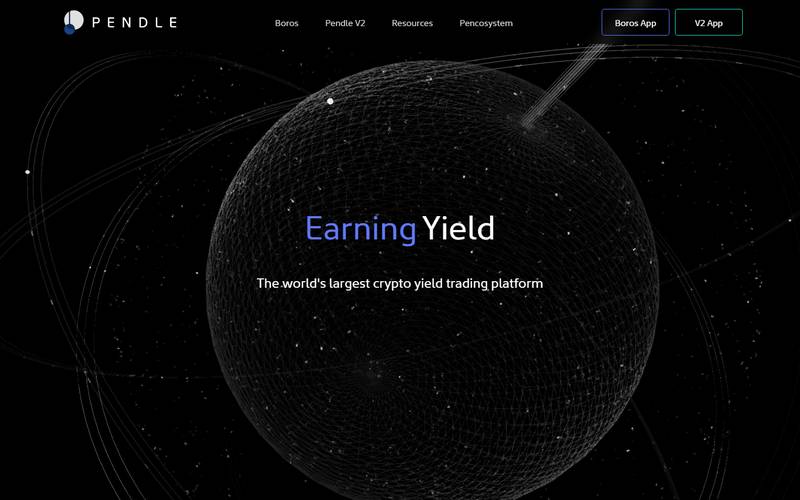
The Pendle interface on a 1440px desktop screen, showing the market list with assets, PT/YT APY, maturity dates, TVL, and the trade panel.
Best for: Browsing available markets, comparing fixed yields across maturities, and managing PT/YT positions. Recommended for your first time using the protocol.
On a Tablet: iPad (1024px wide)
Pendle on an iPad at 1024px. The market list and trade panel remain accessible side-by-side.
Best for: Monitoring your positions and yield rates on the go.
On a Phone: iPhone 16 Pro Max (430px wide)
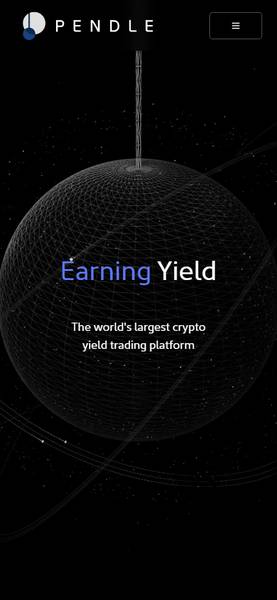
Pendle on an iPhone 16 Pro Max at 430px. Markets list in a single column; the trade interface is accessible per market.
Best for: Checking yields and position values. For initial setup and choosing markets, a desktop view is much more informative.
The Core Mechanic: How PT and YT Work
Let's use a concrete example. Suppose you hold 1 weETH (wrapped eETH from EtherFi, it earns Ethereum staking rewards at approximately 4% APY).
Without Pendle: You hold 1 weETH. You earn 4% APY (variable, could change any day).
With Pendle:
Your 1 weETH is split into:
- 1 PT-weETH (maturing December 31, 2026): This is worth slightly less than 1 weETH today, the discount represents the yield you are forgoing. If the implied fixed yield is 4%, you might buy 1 PT-weETH for ~0.98 weETH today and receive exactly 1 weETH on December 31.
- 1 YT-weETH (maturing December 31, 2026): This is worth the present value of all the yield from 1 weETH between now and December 31. It pays out daily as weETH generates staking rewards.
Who uses PT: Lenders, treasury managers, and yield farmers who want predictable returns. You know exactly what you will have on December 31 regardless of what the Ethereum staking rate does.
Who uses YT: Yield traders who believe current DeFi yields are about to increase. If you buy YT cheaply when yields are low and yields double, the daily payouts from YT also double, making your YT worth more than you paid.
The key insight: PT + YT = the original asset (1 PT-weETH + 1 YT-weETH = 1 weETH in economic terms). You can always reconstruct the original asset by holding both.
Core Products
Trade (PT and YT Markets)
Pendle's primary interface shows all available markets sorted by asset type. Each market displays:
- The underlying yield-bearing asset (stETH, USDe, sUSDe, weETH, etc.)
- The PT fixed APY (the locked-in annual return if you buy PT today and hold to maturity)
- The implied yield (what the market believes the underlying asset will average over the remaining period)
- Maturity date
- TVL and liquidity
Buy PT (Fixed Yield)
Click "PT" on any market, enter the amount you want to invest, and confirm. You receive PT tokens. At maturity, redeem them for the full face value of the underlying asset. The yield you earned is the difference between what you paid and what you receive, locked in at purchase time.
Buy YT (Yield Trading)
Click "YT" on any market. YT is cheap (typically 1-10% of the asset's face value) because it only represents yield, not principal. It pays out daily as the underlying generates yield. If the yield rate exceeds the implied rate you paid for, you profit. If yields collapse, your YT loses value, it can go to near-zero if yields are very low for extended periods.
Provide Liquidity (LP)
Provide liquidity to Pendle's AMM (which is specifically designed for yield tokens, not standard AMMs). LPs earn swap fees from PT/YT traders plus incentives. Note: Pendle's AMM has specific impermanent loss characteristics different from standard AMMs, understand these before LPing.
sPENDLE (Staking)
Lock PENDLE to receive sPENDLE. sPENDLE holders receive:
- A share of protocol revenue (30-day holders revenue: $337,835)
- Governance voting rights
- Boosted yields on LP positions (higher PENDLE emissions)
Connecting Your Wallet (Live Screenshot)
We opened Pendle Finance on 29 October 2026 and clicked "Connect Wallet" to test the connection flow live.
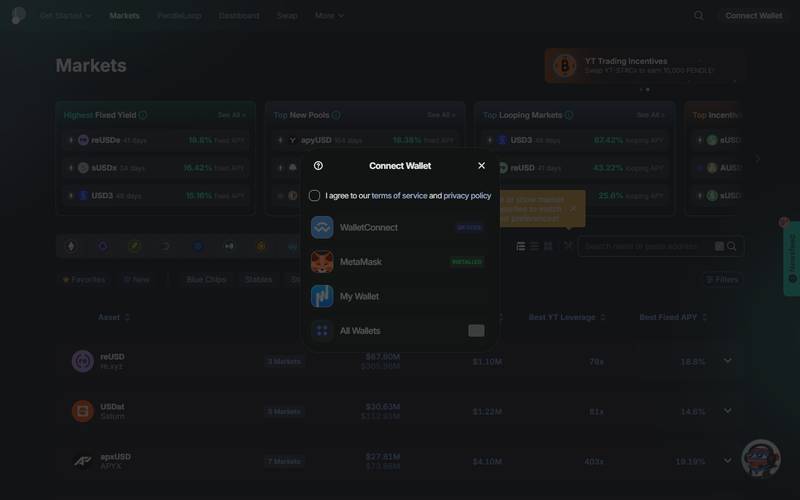
the Pendle markets page requesting wallet access to view yield positions.
How to connect:
- Go to https://app.pendle.finance/trade/markets
- Click "Connect Wallet" (or "Connect" / "Sign In" depending on the site)
- Select MetaMask from the wallet picker
- In the MetaMask popup, click "Connect"
- Sign the message if prompted (confirms wallet ownership: no transaction authorised)
Once connected, the top-right corner shows your shortened wallet address and your balances appear in the interface.
How to Buy PT for Fixed Yield (Step by Step)
What you need:
- A Web3 wallet (MetaMask, Coinbase Wallet, etc.)
- The yield-bearing asset you want to fix the yield on (e.g. USDC, ETH, stETH, USDe)
- A small amount of ETH for gas (or use Arbitrum/Monad for lower fees)
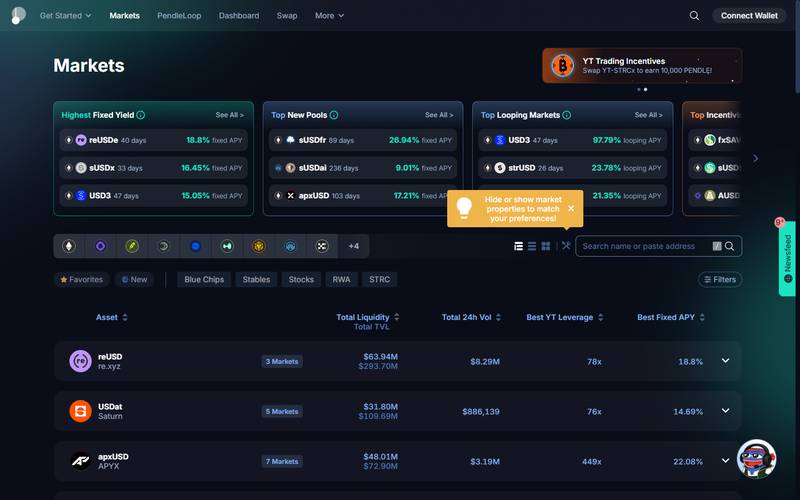
The Pendle markets list, filter by chain, asset type, or expiry date.
Step 1, Go to Pendle and Connect Your Wallet
Go to https://pendle.finance. Click "Connect Wallet" and approve. Navigate to the "Trade" section.
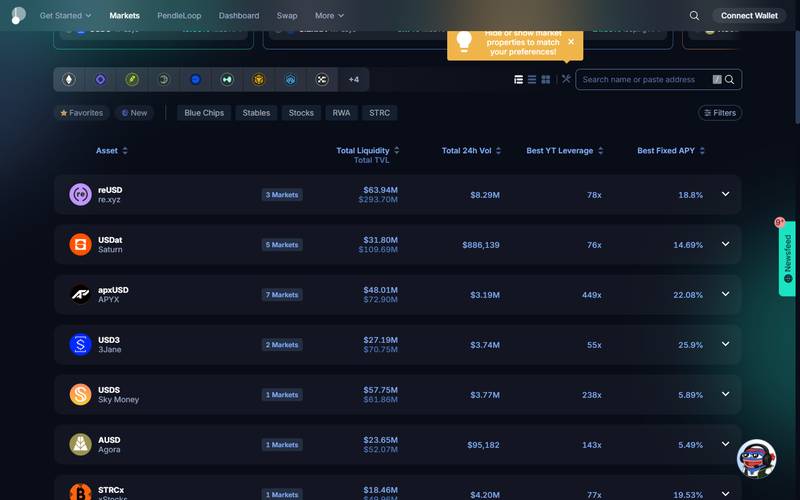
Click a market to see PT and YT prices, implied APY, and liquidity depth.
Step 2, Find a Market
Browse the market list. Filter by asset type (stablecoins, ETH yield, LRT, etc.) or by chain. Compare the Fixed APY column, this is what you lock in if you buy PT today and hold to maturity.
Note the maturity date. A 3-month PT with 6% fixed APY is not the same as a 1-year PT with 6% fixed APY, the first returns your capital in 3 months, the second in a year.
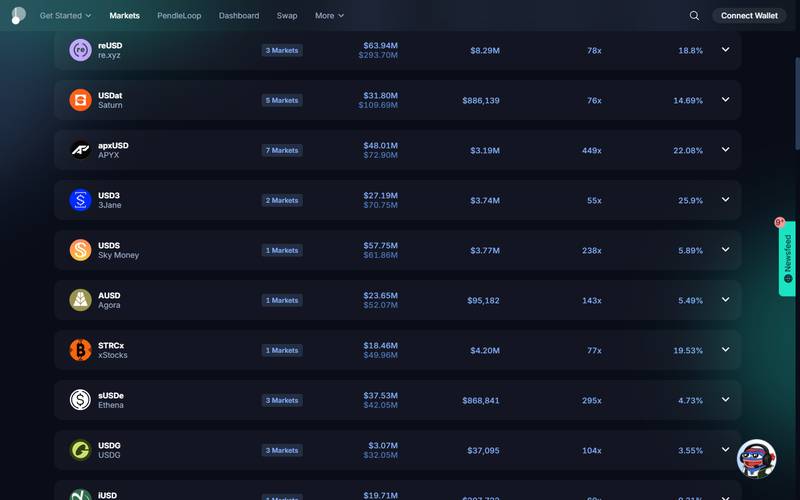
Buy PT (fixed yield) by selecting the amount and confirming the swap.
Step 3, Click a Market and Select PT
Click the market you want. Select the "PT" tab in the trade panel. Enter the amount you want to invest (in the underlying asset or USDC, depending on the market).
The interface shows:
- Amount of PT you will receive
- Effective fixed APY (what your locked-in return annualises to)
- Maturity date
- Current price of PT vs. the underlying
Your portfolio shows all PT, YT, and LP positions with maturity dates.
Step 4, Confirm the Trade
Click "Swap" and confirm in your wallet. You receive PT tokens. Keep them until maturity.
At expiry, PT redeems 1:1 for the underlying, no action needed.
Step 5, Redeem at Maturity
On or after the maturity date, return to Pendle, find the matured market, and click "Redeem". Your PT tokens convert back to the underlying asset at face value. You receive exactly what was promised when you bought, the fixed return.
What Pendle Is NOT: Common Misunderstandings
"PT is risk-free", It is not. PT's fixed return assumes the underlying asset does not default or depeg. If Ethena USDe loses its peg, PT-USDe may not redeem at face value. The fixed rate is fixed in terms of USDe, not USD.
"YT is a simple high-yield bet", YT has time decay built in. Even if the underlying yield stays exactly as high as when you bought, your YT approaches zero by maturity because the payout period gets shorter. You need yields to be meaningfully higher than what you paid for YT to profit.
"LP in Pendle works like LP in Uniswap", Pendle's AMM is specifically designed for yield tokens with a convergence curve (prices converge toward a predictable value at maturity). The risk profile and impermanent loss characteristics are different from standard AMMs.
PENDLE Tokenomics
| Metric | Figure (October 2026) |
|---|---|
| Token ticker | PENDLE |
| Current price | ~$1.90 |
| 30-day holders revenue (sPENDLE) | $337,835 |
| Annualised holders revenue | ~$4M (estimated) |
| Cumulative holders revenue | $56.83M |
| Fee take rate | ~3-5% of yield flows |
| Staking token | sPENDLE (locked PENDLE) |
| TVL | $1.069B |
| Chains | 13+ |
| Cumulative fees | $68M |
sPENDLE revenue model: Protocol fees on Pendle come from YT yields and swap fees. Of these, a portion goes to sPENDLE holders. With $337K in holders revenue over 30 days and PENDLE market cap of ~$400M (based on ~$1.90 price), the current yield from staking is modest, roughly 1% annualised on staked PENDLE at current fee levels and TVL.
Why TVL declined from $13.4B to $1.06B: Pendle TVL is highly sensitive to DeFi market conditions. At peak (September 2025), massive capital inflows into LRT (Liquid Restaking Tokens) and Ethena USDe yield products drove TVL up. As those yields normalised and market conditions shifted in early 2026, capital exited. TVL is recovering with a +68% increase in weekly volume seen in recent data.
Security: What You Need to Know
- Audits: Code reviewed by Ackee, Dedaub, Dingbats, and a Code4rena contest
- Non-custodial: Your assets stay in smart contracts you directly control
- No known major exploits: Pendle has operated since 2021 without a significant hack
Key risks:
- Underlying asset risk: If the yield-bearing asset Pendle wraps (e.g. USDe, stETH) loses its value or has an exploit, PT and YT holders bear that loss. Pendle's security does not protect against the underlying asset failing.
- YT time decay: As explained above, YT loses value continuously toward maturity. Misunderstanding this mechanism is the most common source of user losses.
- Liquidity risk: Less popular Pendle markets can have thin liquidity. Selling a large YT position in a thin market will move the price significantly against you.
- Smart contract risk: Despite audits, complex DeFi protocols can contain bugs. Only deploy capital you can afford to lose.
Pendle vs Competitors
| Feature | Pendle | Spectra | Notional Finance | Standard lending (Aave) |
|---|---|---|---|---|
| Fixed-rate mechanism | Yield tokenization (PT/YT) | Yield tokenization | Fixed-rate lending | Variable only |
| Yield trading | Yes (YT) | Partial | No | No |
| TVL | $1.069B | Smaller | Smaller | $17.77B |
| Chains | 13+ | Ethereum mainly | Ethereum | 23 |
| Token fee capture | Yes (sPENDLE) | Partial | No | No |
| Complexity | High | High | Medium | Low |
| Market leader | Yes (50-60% of DeFi yield trading) | No | No | Competitor category |
Pros and Cons
Pros
- World's leading yield tokenization protocol, 50-60% market share in DeFi yield trading
- Fix today's yield rates as guaranteed returns via PT (unique in DeFi at scale)
- sPENDLE distributes real protocol fees to token stakers ($56M cumulative)
- 13+ chains, access yield opportunities across the entire EVM ecosystem
- $68M in cumulative fees, proven, sustained usage
- Ideal for institutional treasuries and structured finance use cases
- Audited by multiple security firms
Cons
- TVL has fallen 92% from its $13.4B peak, significantly reduced footprint
- YT complexity is a common source of user losses for those who misunderstand time decay
- Low current fee generation ($459K/30 days) relative to historical peak
- PENDLE price is ~73% below its estimated 2025 high, investors have seen large drawdowns
- Complex mechanics, one of the harder DeFi protocols to understand intuitively
- Underlying asset risk cannot be diversified away by Pendle's own protocol design
Verdict
Who Pendle is for:
- Yield farmers who want predictable, fixed returns on DeFi assets they already hold, buying PT gives you clarity in an environment of variable rates.
- Yield traders who have a strong view that specific DeFi rates will increase, buying YT cheaply when rates are low can produce outsized returns if you are right.
- DeFi power users and institutional treasuries who manage multiple yield positions and want rate hedging tools.
- PENDLE stakers who believe TVL will recover from its 2026 decline, sPENDLE revenue scales directly with protocol activity.
Who should look elsewhere:
- Beginners who want simple passive yield, deposit USDC into Aave or Morpho instead. Pendle's complexity adds risk without proportional reward for unsophisticated users.
- Users who do not understand YT time decay, buying YT without understanding this mechanism is a reliable way to lose money.
- Investors seeking a near-term price recovery story, PENDLE at $1.90 is 73%+ below its 2025 high, and recovery depends on sustained TVL growth back toward $3-5B.
Rating: 3.8 / 5
Pendle's core innovation, yield tokenization and fixed-rate DeFi, is genuinely original and has attracted institutional and retail capital at scale. The $56M in cumulative holder revenue confirms the protocol creates real value. The significant TVL decline from peak, the complexity that traps inexperienced users, and the PENDLE token's drawdown from its 2025 highs all temper enthusiasm for 2026. For experienced DeFi users managing significant yield positions, Pendle remains the best tool in its category.
Quick Links
- Main platform: https://pendle.finance
- Official documentation: https://docs.pendle.finance
- Protocol data (DefiLlama): https://defillama.com/protocol/pendle
- PENDLE token (CoinGecko): https://www.coingecko.com/en/coins/pendle
- PENDLE token unlocks: https://defillama.com/unlocks/pendle
Last verified: October 29, 2026. Data sourced from DefiLlama, CoinGecko, CoinBureau, FalconX Newsroom, and Pendle Finance official documentation.