
















JPMorgan dollar outlook: falling U.S. dollar isn’t a crisis
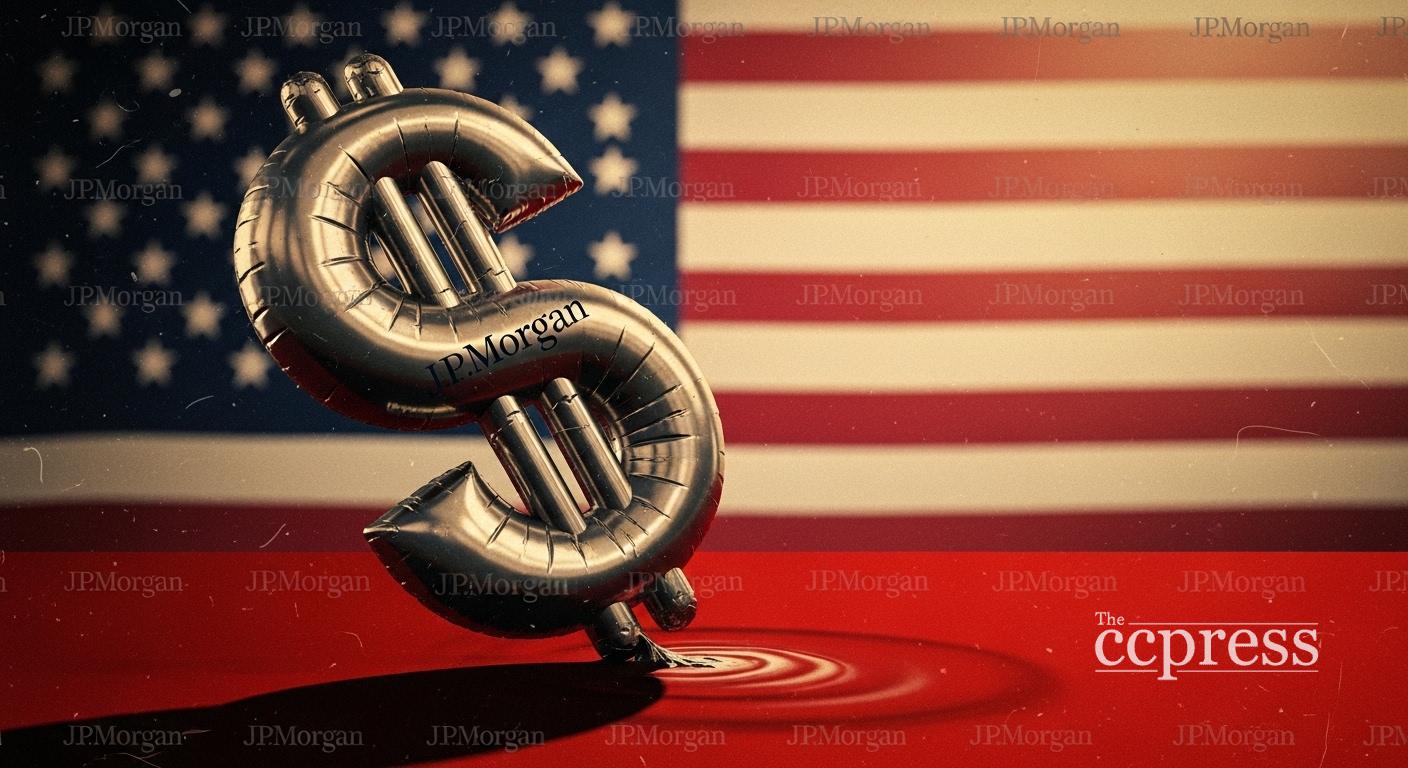
The recent slide in the U.S. dollar has stirred debate, but the underlying signals point to a normalization rather than a dislocation. In this framing, dollar weakness reflects valuation adjustment and evolving global capital preferences, not a breakdown in the currency’s role or in market functioning.
Key macro levers, valuation, global rebalancing, and hedging flows, help explain the move without invoking crisis dynamics. Interest-rate differentials and the composition of capital flows are shifting, while measures beyond the headline U.S. Dollar Index (DXY) suggest the greenback has room to ease without threatening market stability.
Key drivers: valuation, real trade-weighted dollar, flows, hedging
According to J.P. Morgan Private Bank, the dollar screens as overvalued by roughly 5–15% on long-run metrics, and recent weakness aligns with international portfolio rebalancing and renewed FX hedging that can gradually erode prior dollar strength. The team also points to the real trade-weighted dollar, an inflation-adjusted basket that captures a broader set of trading partners, as still elevated historically, implying scope for mean reversion. Inflows that previously concentrated in U.S. assets have slowed, and foreign investors who reduced hedges during the strong-dollar phase are now adding them back, reinforcing incremental depreciation rather than disorderly selling.
Two tools clarify the backdrop. DXY tracks the dollar against a narrower set of developed-market currencies, while the real trade-weighted index (real TWI) adjusts for inflation and a wider trading base, often giving a better sense of competitiveness and cycle positioning. Rate differentials, capital flows into ex‑U.S. equities, and the cost/benefit of hedge ratios are moving pieces that can push the dollar lower without signaling systemic stress.
Some policymakers have flagged unusual market pairings that bear monitoring, particularly the mix of higher Treasury yields alongside a softer dollar. “The combination of rising Treasury yields and a falling dollar is unusual,” said Neel Kashkari, President of the Minneapolis Fed, noting that it can reflect changing perceptions of U.S. safe-haven appeal. While that observation is not, by itself, a crisis call, it underscores why investors are watching flows, yield curves, and FX hedging behavior in tandem.
What this means for stocks, ex-U.S. assets, and commodities
For U.S. equities, a weaker dollar can be a translation tailwind to large multinationals’ overseas revenues, even as imported input costs may rise; the net effect varies by sector and supply-chain mix. If the move remains valuation- and flow-driven, equity volatility need not spike, but earnings dispersion could widen between domestic and globally diversified businesses.
Ex‑U.S. assets can benefit if global investors rotate toward non‑U.S. equities and local-currency debt, with some support to emerging‑market FX from a softer dollar. As a counterpoint, BCA Research and other macro houses have warned that large U.S. fiscal deficits and political uncertainty could contribute to a longer-term dollar downtrend, a scenario that would amplify relative performance shifts but also raise policy and market-structure questions.
Many commodities are priced in dollars, so a weaker greenback can be supportive at the margin for gold, energy, and industrial metals, all else equal. At the time of this writing, Bitcoin traded near $69,937 and Barrick Mining Corporation shares were around $47.92, contextual figures that illustrate how cross-asset pricing sits alongside FX moves without implying direct causality. As always with currencies, the path is conditional: if rate spreads, capital flows, and hedging costs keep converging, the dollar can ease further in an orderly way; if growth or policy surprises hit, FX dynamics can pivot quickly.
| Disclaimer: The content on The CCPress is provided for informational purposes only and should not be considered financial or investment advice. Cryptocurrency investments carry inherent risks. Please consult a qualified financial advisor before making any investment decisions. |