



















Cryptocurrency is on everyone’s lips right now and has started drawing in even some of the most pragmatic investors for a couple of years now. Similar to the situation when people flocked to California in 1848 for the gold rush, cryptocurrency has drawn a great number of miners since its birth.
In various ways, cryptocurrency mining works fairly similar to gold mining. The Bitcoin system has a set limit of 21 million Bitcoins, and 4 million are still available for mining.
A few words on Bitcoin mining
 Cryptocurrency mining (this includes Bitcoin mining as well) involves the releasing of new cryptocurrency into the system and verifying and adding transactions to the blockchain public ledger.
As most of you already know, crypto mining is done using an Internet-connected computer which usually requires special mining hardware and software. Even though in the early days, anyone with a decent computer could mine Bitcoin, over the years, finding new blocks got computationally more difficult.
After all, crypto mining is a calculation-heavy computation process that requires extremely high processing power which usually results in high electricity consumption. The practical principle behind is quite simple: the miner who first solves the puzzle gets to place the next block on the blockchain and claims a reward for it. The miner could become the owner of the newly release Bitcoin, or it could get fees linked to the transactions performed in the specific block.
Bitcoins are mined in units called blocks. To put things into perspective, in 2009 when the first Bitcoin was first mined, mining one block would provide users with a reward of 50 BTC. In 2012, this was halved to 25 BTC, and in 2016, halved once more to 12,5. This means that in 2020, the reward will be once more halved to 6,25 BTC
What are Bitcoin mining pools?

As more and more miners attempt to grab a “piece of the pie,” finding new blocks gets computationally more difficult, requiring more computational power and, in the case of Bitcoin, it can get to a point where it’s so expensive that individual mining makes no sense.
This is where mining pools come into play. A mining pool can be defined as a group of miners working together to increase their chances of finding a block. These pools ensure that miners combine their individual computational resources with those of other members.
As one can imagine, this pooled work ensures better output and higher chances of completing a block, but it doesn’t come without a cost. In short, the reward earned through this collaborative process is split among all the involved pool members.
How do mining pools work?
You can think of a mining pool as a coordinator for the pool members. A mining pool involves managing the pool members’ hashes, recording the work performed by each pool member, and assigning reward shares to each pool member according to their work.
There are two ways of assigning work to pool members. The first involves assigning members a work unit comprised of a specific range of nonce. The member places a request for a new work unit only after the current work is completed. The second method allows pool members the liberty to pick and choose as much work as they like without any assignment coming from the pool. The main benefit of this method is the fact that no two members can take the same assignment.
Reward sharing
Shares describe how much work a particular member has contributed with. There are two kinds of shares: accepted and rejected. If the work done by a pool member is considered to substantially contribute towards discovering new cryptos, it gets rewarded and it’s called accepted share.
Rejected shares represent work that does not directly contribute to a blockchain discovery, meaning it is not paid for. It’s important to note that a share, on its own, has no actual value. You can think of shares as straightforward accounting methods to keep the reward distribution within the pool as fair as possible.
Members get rewarded using different methods based on the accepted shares as follows:
Pay-per share (PPS)
This method implies the offering of an instant flat payment per solved share. This method allows miners to withdraw their earnings instantly from the pool’s existing balance.
Proportional (PROP)
At the end of a mining round, a reward is offered. The reward is proportional to the number of the member’s shares with respect to total shares in the pool.
Shares Maximum Pay Per Share (SMPPS)
The shares maximum pay per share method has a lot in common with the first PPS method. The main difference between the two is the fact that this method limits the payout to the maximum that the pool has earned.
Equalized Shared Maximum Pay Per Share (ESMPPS)
This method is fairly similar to SMPPS, but distributes the payment is equally distributed among all the pool members.
Other reward options include the Double Geometric Method (DGM), Recent Shared Maximum Pay Per Share (RSMPPS), Capped Pay Per Share with Recent Backpay (CPPSRB), and Bitcoin Pooled Mining (BPM).
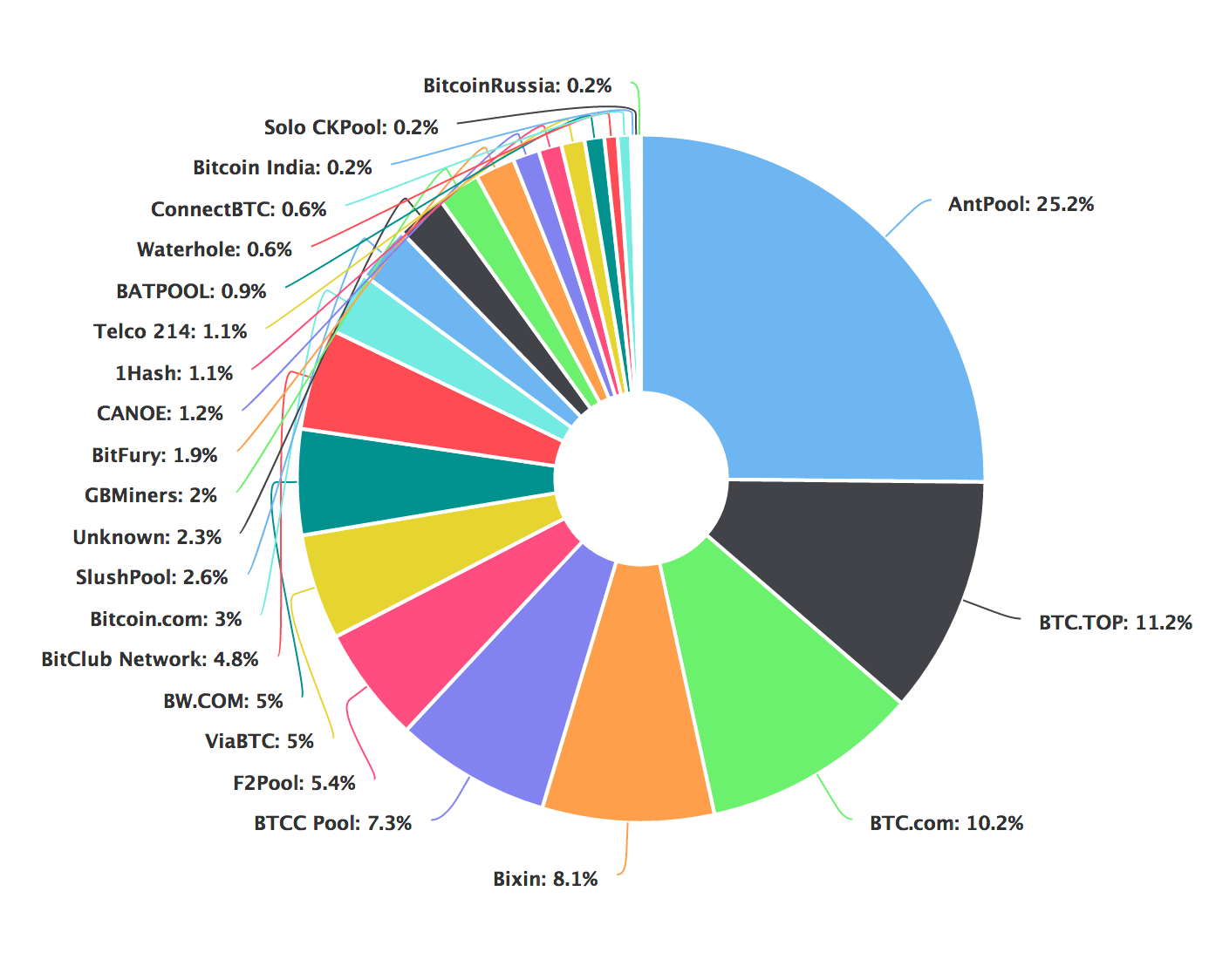
List of top Bitcoin mining pools
If Bitcoin mining is a concept that is appealing to you, you might want to check out some of the most popular Bitcoin mining pools out there such as AntPool, BTC.com, BTC.TOP, ViaBTC, Slush.
The bottom line
Joining a mining pool in order to increase your revenue via mining can be a good thing. However, before deciding to join a particular pool, miners should learn how pool shares work and what are the associated fees. Usually, pools charge somewhere between 1% and 3% as pool fees.
With the decision of joining a mining pool, miners basically sign up for high-probability but limited profits, instead of low-probability high profits.