
Tokenization does not automatically remove a financial instrument from securities law. A tokenized security can use a blockchain to record ownership while still representing a security under federal law. Conversely, a digital tool or stablecoin may be analysed differently from a digital security, but the label chosen by a project is not the evidence that settles the result.
Key takeaways
- Classification depends on the asset, rights, transaction, and intermediary role; a token ticker is not a legal conclusion.
- Tokenized securities remain a separate category from digital tools, digital commodities, and stablecoins, even when all use the same blockchain infrastructure.
- The safest reporting language identifies the SEC source and status: interpretation, staff statement, filing, enforcement action, court holding, or unresolved question.
What the SEC classifies as a digital commodity
The SEC’s March 2026 interpretation expressly places a named group of network assets in the digital-commodity category rather than treating the assets themselves as securities. The SEC’s educational page lists Aptos (APT), Avalanche (AVAX), Bitcoin (BTC), Bitcoin Cash (BCH), Cardano (ADA), Chainlink (LINK), Dogecoin (DOGE), Ether (ETH), Hedera (HBAR), Litecoin (LTC), Polkadot (DOT), Shiba Inu (SHIB), Solana (SOL), Stellar (XLM), Tezos (XTZ), and XRP (XRP) as examples of digital commodities.
That is a materially different answer from saying “crypto is not a security.” The assets in the list are used to participate in a functional crypto system, and their value is described as coming from the system’s programmatic operation plus supply and demand. The list is also date-sensitive: it records the SEC’s position as published in 2026, not a permanent statutory safe harbour for every future offering or transaction.
| SEC category | Named market examples | What the classification answers | What it does not answer |
|---|---|---|---|
| Digital commodity | APT, AVAX, BTC, BCH, ADA, LINK, DOGE, ETH, HBAR, LTC, DOT, SHIB, SOL, XLM, XTZ, XRP | The SEC’s current view that these assets themselves fit the digital-commodity description | Whether a sale, staking arrangement, lending product, ETP share, or derivative is also a digital commodity |
| Digital collectible | CryptoPunks, Chromie Squiggles, fan tokens, WIF, VCOIN | The asset is designed for collecting or conveying a reference to art, media, a character, trend, or event | Whether fractionalisation or attached profit rights turn the arrangement into a security |
| Digital tool | Ethereum Name Service domain names and CoinDesk’s Microcosms NFT Consensus Ticket | The asset performs a practical function such as access, membership, ticketing, credential, title, or identity | Whether a project used utility language to market an investment contract |
| Payment stablecoin | A stablecoin designed for payment or settlement and subject to the GENIUS Act conditions | The payment function and statutory conditions that support non-security treatment | Whether every dollar-pegged, yield-bearing, redeemable, or reserve-backed token qualifies |
| Digital security | A tokenised share, fund interest, debt instrument, or other financial instrument | The crypto representation still carries the legal rights and obligations of the underlying security | Whether a token ticker alone proves ownership, voting, redemption, or economic rights |
The SEC’s crypto-assets reference page is the source for the named examples above. The article should therefore use wording such as “the SEC lists BTC and ETH as digital-commodity examples in its 2026 guidance,” rather than “BTC and ETH can never be securities.”
The classification does not operate like a permanent label attached to a token. The same asset can be involved in different transactions, and the transaction can change what a buyer receives, what a promoter promises, and whether an intermediary is performing a regulated function. That is why this article treats classification as a dated source-and-transaction analysis rather than a coin ranking.
Tokenized securities already trading in the market
The practical answer is that the SEC’s 2026 taxonomy identifies digital securities by the financial instrument they represent, not by a universal Binance Philippines crypto-services approval ticker list. A tokenised Treasury fund share, tokenised equity interest, tokenised debt instrument, or tokenised private-fund interest can be a digital security because the holder is receiving an interest in a traditional financial instrument.
| Market instrument | What the token represents | Why it belongs in the digital-security analysis | Evidence the reader should inspect |
|---|---|---|---|
| BlackRock USD Institutional Digital Liquidity Fund (BUIDL) | Shares in a fund investing primarily in cash, U.S. Treasury bills, and repo agreements | The token represents a regulated fund interest, not just a unit used to pay for network services | Offering documents, transfer restrictions, eligible-holder rules, and the fund administrator |
| Franklin OnChain U.S. Government Money Fund (FOBXX / BENJI) | Shares in a registered money-market fund recorded through a blockchain-based transfer system | The underlying asset is a fund share with redemption and shareholder-right questions | Fund prospectus, shareholder records, transfer-agent disclosures, and redemption terms |
| Tokenised corporate or private credit note | A debt claim against an issuer or obligor | The holder may have repayment, interest, priority, and enforcement rights | Note terms, issuer, collateral, maturity, default provisions, and distribution restrictions |
| Tokenised equity or fund interest issued through a platform | A share or beneficial interest in a company or investment vehicle | The blockchain record does not erase voting, economic, or disclosure rights attached to the underlying instrument | Issuer documents, ownership register, transfer restrictions, and applicable registration or exemption |
These are market instruments to analyse as potential digital securities, not a claim that the SEC has issued a separate ticker-by-ticker classification for each one. In practice, the decisive evidence is the legal wrapper and holder rights. A token that gives a holder a claim on fund assets is materially different from BTC used to pay network fees, even if both trade through a crypto wallet.
The SEC’s statement on tokenized securities makes the same point: tokenisation changes how ownership is represented or recorded, but it does not by itself change the nature of the underlying financial instrument.
How a non-security asset can still be sold through an investment contract
An asset’s category and the transaction used to sell it must be separated. The SEC’s transactions guidance explains that a non-security crypto asset can still be offered and sold subject to an investment contract when buyers invest money in a common enterprise and reasonably expect profits from the essential managerial efforts of others.
This is why the same BTC, ETH, or XRP ticker cannot answer every legal question. A secondary purchase of an asset listed by the SEC as a digital commodity is not automatically identical to an issuer’s fundraising sale that includes promises about development, price appreciation, or managerial work. The article must name the asset, the seller, the promise, the buyer’s rights, and the transaction date before drawing a conclusion.
The following table turns the distinction into a usable research test:
| Scenario or test | Evidence to inspect | What it can establish | What it cannot establish alone |
|---|---|---|---|
| Buying BTC on a spot exchange | Asset, venue entity, custody terms, customer location, and trade terms | Whether the spot asset and platform service fit the SEC’s current framework | Whether a related future, perpetual, lending product, or issuer sale has the same result |
| Buying ETH from an issuer during a fundraising campaign | Sale agreement, marketing, issuer promises, allocation, and delivery terms | Whether the transaction raises an investment-contract question | That every secondary ETH trade is a securities transaction |
| Buying a BUIDL or FOBXX token | Prospectus, transfer-agent record, eligible-holder rules, redemption process, and fund rights | The legal wrapper, underlying fund interest, and holder restrictions | That the token ticker alone proves the full rights of the underlying fund share |
| Buying a dollar-pegged token that pays yield | Reserve, redemption, yield, issuer, distribution, and customer agreement | Whether the product looks like a qualifying payment stablecoin or carries investment or income rights | That every dollar-pegged token receives the same treatment |
| Holder rights | Terms, offering documents, contracts, and governance records | Economic, governance, redemption, or usage rights | Whether every secondary trade has the same legal result |
| Asset control | Issuer entity, development control, upgrade process, and supply records | The people or entity behind supply, upgrades, or promises | That control automatically makes the asset a security |
| Distribution method | Offering page, sales agreement, marketing, and allocation records | The transaction context and buyer expectations | A final legal conclusion without applying the facts |
| Intermediary function | Exchange, broker, custody, execution, advice, or settlement terms | The service performed and possible registration question | That the whole group has one licence |
| Regulatory position | Interpretation, order, filing, enforcement action, or court decision | The status and scope of the official position | That an informal summary is binding law |
This table is the practical distinction between a research article and a ticker list. It forces the writer to state which evidence supports the sentence being published.
Digital securities and tokenized securities
The practical answer is to identify the mechanism, the responsible entity, and the evidence that can be checked today. The SEC’s statement on tokenized securities describes a tokenized security as a financial instrument that meets the definition of a security and is formatted as or represented by a crypto asset. The ownership record can be maintained in whole or in part through a crypto network.
That definition matters because tokenization changes the record and transfer technology, not necessarily the legal rights. A share, fund interest, debt instrument, or other financial asset can be represented through a token while still carrying restrictions around transfer, custody, disclosure, settlement, and investor rights. There are at least two important models to distinguish:
- Issuer-sponsored tokenization: the issuer or an affiliated party creates the tokenised representation of its own security.
- Third-party tokenization: another party creates a token that represents an interest in a security held or controlled through a separate arrangement.
The second model makes the chain of rights especially important. A token holder may not receive exactly the same voting, dividend, redemption, bankruptcy, or enforcement rights as the holder of the underlying security. A published comparison should therefore identify the legal wrapper, the underlying custodian, the transfer restrictions, and the mechanism for converting or redeeming the token.
Digital commodities are not a shortcut around analysis
A digital commodity label does not settle every securities-law question. The phrase “digital commodity” can be useful when discussing an asset that has commodity-like characteristics, but it should not be used as a blanket answer to every securities-law question. The writer still needs to separate the asset from the transaction, the venue, and the services performed around it.
The practical conclusion is that the SEC’s 2026 interpretation describes digital securities as financial instruments represented by crypto assets, but it does not determine the status of every token or secondary transaction. Each conclusion still depends on the asset’s rights, the transaction structure, the intermediary’s role, and the most recent primary document.
This is where the CFTC crypto derivatives guide should be linked. Readers need to understand that an asset’s treatment does not automatically determine the legal status of every product built around it.
The useful data points are product type, venue, customer eligibility, margin, clearing, settlement, and market-surveillance arrangements. A table that only says “coin: commodity” hides the more important market-access question.
Stablecoins need an issuer and transaction analysis
The decisive variables are the token category, issuer, reserve evidence, and redemption rights. Stablecoins are often described as one category, but their design and use can differ materially. A payment stablecoin, an asset-referenced token, an interest-bearing product, a token that offers another financial right, and a token used only inside a software system can raise different questions.
The SEC’s crypto-asset material identifies stablecoins as a category for analysis, but that does not mean that every token using a dollar peg has the same status. A writer should inspect reserve language, redemption rights, yield promises, governance, issuer control, distribution, and the role of intermediaries.
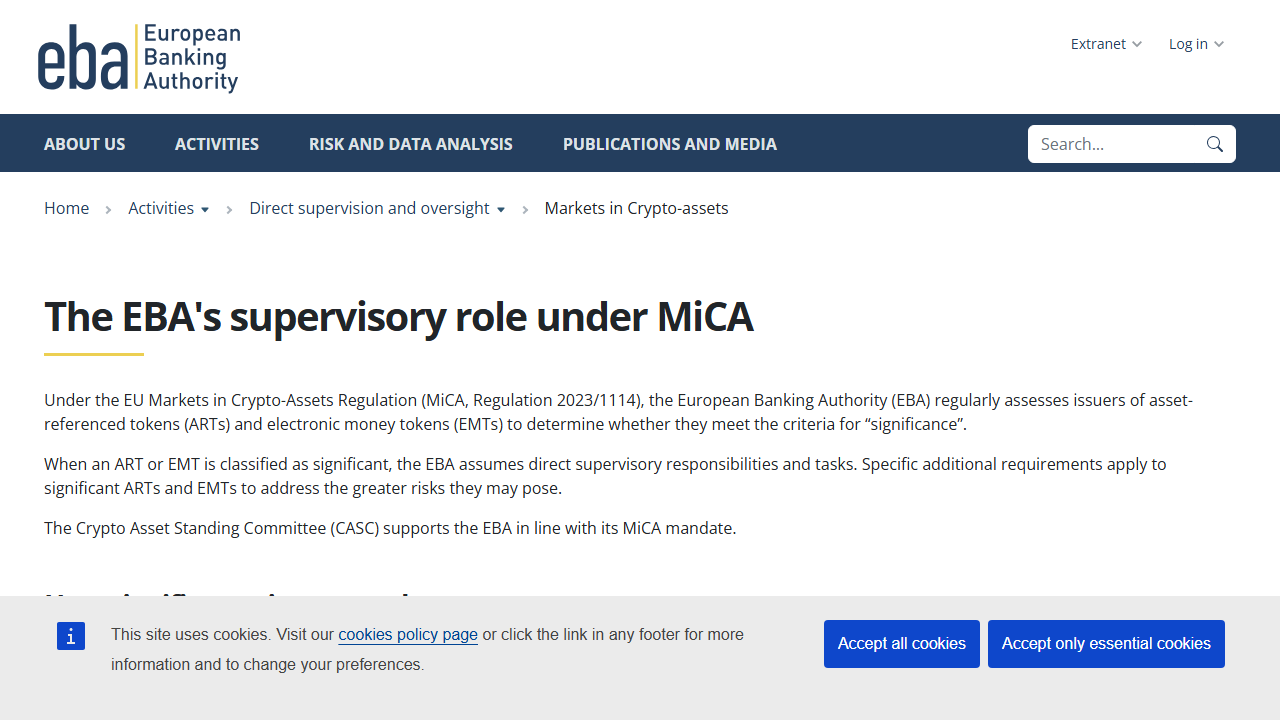
The comparison also needs to distinguish US analysis from the EU’s MiCA framework. The MiCA stablecoin rules guide covers ARTs, EMTs, reserves, redemption, and EBA supervision. Using a European stablecoin rule to make a universal US securities-law claim is a category error.
Digital tools and utility claims
Digital tools can perform functions such as membership, access, credentials, tickets, or identity. The practical question is whether the tool’s function is real and central to the transaction, or whether utility language is being used to describe an asset sold primarily through an investment narrative.
Evidence should record what the buyer receives, where it can be used, whether it can be redeemed, whether the function is live, and whether the promoter makes an expectation-of-profit claim. A project roadmap is not proof that a product is already functional. A loyalty badge is not automatically an investment contract, but a non-transferable label does not automatically settle every other issue either.
This is the section where editorial precision matters most. Avoid writing “the token is a utility token” unless the source is making that exact legal conclusion. Prefer: “The project describes the token as a tool used for X; the available documents do not by themselves establish how every transaction would be treated.”
Intermediary roles in asset classification
The intermediary role can change the regulatory analysis even when the underlying asset stays the same. Many classification articles focus on the token and skip the intermediary. That misses where users experience regulation. An Binance Philippines crypto-services approval, broker, adviser, custodian, transfer agent, wallet interface, or settlement provider can perform a different function even when the same asset is involved.
For a platform review, build a service map:
| Service | Questions to verify | Evidence |
|---|---|---|
| Listing or venue access | Named entity and admission process | Listing policy, legal entity, venue rules |
| Execution | Routing, matching, or transmission role | Terms, execution policy, registration disclosures |
| Custody | Key and withdrawal controller | Custody agreement, custodian name, segregation language |
| Advice or promotion | Recommendation and promotion role | Research, marketing, suitability, disclosures |
| Settlement | Record, clearing, and transfer role | Settlement terms, network, counterparty, service scope |
The Binance Philippines crypto-services approval gives readers a way to validate this map. The important field is not just “regulated: yes/no.” It is legal entity, authority, activity, geography, status, and date. The related market context is covered in crypto regulator watchlist, SEC-CFTC futures framework, Taiwan crypto regulatory framework.
Conclusion
The safest SEC classification conclusion names the source and publication date, identifies whether it is an interpretation, rule, staff view, filing, enforcement action, or court decision, and describes the category or transaction it actually addresses. It also states what the source does not decide and identifies the next document or fact that could change the analysis.
The practical conclusion is that the SEC’s 2026 interpretation describes digital securities as financial instruments represented by crypto assets, but it does not determine the status of every token or secondary transaction. Each conclusion still depends on the asset’s rights, the transaction structure, the intermediary’s role, and the most recent primary document.
The same discipline protects an exchange or firm that publishes educational material. A company can describe the source of its view without presenting a marketing statement as an official safe harbour. A regulator can be cited accurately without turning its page into an endorsement of a product.
Frequently asked questions
Does tokenization make an asset a security?
The practical answer is to identify the mechanism, the responsible entity, and the evidence that can be checked today. No. Tokenization describes the representation or record of an asset through a crypto network. If the underlying financial instrument meets the definition of a security, representing it as a token does not remove that status. Other crypto assets require their own analysis.
Is a digital commodity outside all SEC questions?
The practical answer is to identify the mechanism, the responsible entity, and the evidence that can be checked today. Not necessarily. The asset, transaction, intermediary, venue, and product must be separated. A spot asset and a derivative tied to that asset can create different regulatory questions.
Are stablecoins automatically not securities?
The decisive variables are the token category, issuer, reserve evidence, and redemption rights. No universal answer follows from the word stablecoin. Reserve structure, redemption, yield, rights, issuer, distribution, and transaction design matter, and different jurisdictions apply different frameworks.
Can a project call its token a utility token?
The practical answer is to identify the mechanism, the responsible entity, and the evidence that can be checked today. It can describe its intended use, but the label is not conclusive evidence. The article should test whether the function exists, what buyers are promised, and how the asset is distributed.
Disclaimer: This article is for informational purposes only and does not constitute financial or investment advice. Cryptocurrency and digital asset markets carry significant risk. Always do your own research before making decisions.