
Who This Guide Is For
One point first, because it changes how you read everything below. Liquity itself does not run a website. The team says so on its home page and in its docs. Its contracts sit on Ethereum, and several independent teams run front ends that talk to them. We tested one of them, Liquity.app, and when this guide says “the app” it means that front end. Liquity AG, the company behind the protocol, says on its own page that it has not done due diligence on those operators. That is a safety point we come back to.
How We Tested Liquity
| Step | What we did | Result |
|---|---|---|
| Read the home page | Opened liquity.org and read the front end list | Four independent front ends listed, no official app |
| Open the app | Loaded Liquity.app on desktop | Dashboard loaded with a yellow Safety Mode banner |
| Connect a wallet | Used a MetaMask demo wallet, approved only the connection | Connected, address shown as 0x536…0cD |
| Borrow page | Typed 1 ETH into the collateral box | Preview updated, nothing signed |
| Multiply page | Opened the page and read the form | Form loaded, no deposit possible because the wallet was empty |
| Earn page | Opened the stability pool list and the ETH pool | Pools and a deposit form loaded |
| Stake page | Opened the LQTY staking form | Form loaded with zero balances |
| Docs and audits | Read the docs through a text mirror | Audit list, bug bounty link, risk text |
| Public data | CoinGecko, DefiLlama, GitHub | Pulled on November 26, 2026 |
The demo wallet holds no money. We never signed a message and never confirmed a transaction. Typing a number into a box is not a transaction. Because the wallet is empty, we could not complete any action, and the article says so wherever it matters.
Quick Verdict
Liquity is one of the cleaner designs in DeFi lending. The code cannot be changed, the borrower picks the interest rate, and the system has a clear rule about who gets sold first when prices fall. It is also a small protocol with a history of a serious bug in its second version, and you must trust whichever front end you use.
| Item | Our view |
|---|---|
| Best for | Holders of ETH, wstETH or rETH who want to borrow a dollar coin and can watch a loan |
| Not for | Anyone who wants a fixed rate, a card, a phone app or a cash on ramp |
| Ease of use | Good once you know the words, because the forms are short |
| Transparency | High. Docs are detailed and the rules are written down |
| Main risk | Liquidation, redemption, front end trust and smart contract risk |
| Our editorial score | 7.5 out of 10 |
The score is ours and it reflects what we could verify. It would be higher if we could have opened a real loan.
What Is Liquity (Plain English)
Think of a pawn shop that runs by a rulebook printed on the wall and has no staff. You leave something valuable, say a gold watch, and the shop hands you cash. You get the watch back when you return the cash plus interest. If the watch loses value and your loan gets too big compared to it, the shop sells the watch to cover the loan. No manager can bend the rules for or against you, because the rules are fixed.
Liquity works like that with crypto. You leave ETH or a staked version of ETH in a box called a Trove. The protocol gives you BOLD, a coin designed to be worth one US dollar. You pay interest at a rate you choose. You can pay the loan back whenever you like. If the value of your ETH falls too far against your BOLD debt, the protocol sells your ETH to repay the debt.
Two words are worth learning now.
A stability pool is a shared pot of BOLD. People put BOLD in, and when a loan gets liquidated, the pot repays the debt and takes the ETH. The people in the pot receive that ETH, usually at a discount, and a share of the interest that borrowers pay. This is where the Earn page yield comes from.
A redemption is a safety valve that keeps BOLD near one dollar. If BOLD trades under a dollar, anyone can hand BOLD to the protocol and take out ETH worth a dollar per BOLD. The protocol takes that ETH from the loans with the lowest interest rates first. That is why the rate you pick matters. A low rate saves interest but raises the chance you get redeemed.
Liquity has two versions. Version 1 issues a coin called LUSD and charges a one time fee. Version 2 issues BOLD and lets borrowers set their own rate. This review is about version 2 on the front end we tested, with version 1 mentioned where it matters.
Key Facts
| Fact | Detail | Source |
|---|---|---|
| Chain | Ethereum | Liquity docs |
| Stablecoin (V2) | BOLD | Liquity docs |
| Collateral (V2) | ETH, wstETH, rETH | Liquity docs |
| Minimum debt | 2,000 BOLD | Liquity docs |
| Upfront fee | About 7 days of average interest on that branch | Liquity docs |
| Liquidation penalty | Usually 5% | Liquity docs |
| Max LTV, ETH | 90.91% on the app | Liquity.app |
| Max LTV, wstETH and rETH | 83.33% on the app | Liquity.app |
| TVL shown in the app | About $74 million with 27 million BOLD | Liquity.app |
| TVL on DefiLlama | About $60.0 million (V2) and $120.3 million (V1) | DefiLlama |
| BOLD in circulation | About 26.8 million | DefiLlama stablecoins |
| Code license | Listed as NOASSERTION on GitHub | GitHub |
| Front ends | Liquity.app, DeFi Saver, LQTY.IO, Trove Zero | liquity.org |
The two TVL numbers differ because they count different things and different dates. The app counts one set of contracts, and DefiLlama splits the versions. We did not try to reconcile them.
The App, Page by Page
The Dashboard
A yellow bar at the top of every page said the ETH branch was in Safety Mode and that borrowing restrictions applied. We explain Safety Mode in the risk section, because it is the most important thing we saw on the page. Below the bar the dashboard shows four big cards: Borrow, Multiply, Earn with BOLD and Stake LQTY. Under them sits a table of the three collateral types with an average rate, a max LTV and the total debt. We read ETH at 4.59% average rate, 90.91% max LTV and $12 million of debt. wstETH showed 5.68%, 83.33% and $11 million. rETH showed 4.59%, 83.33% and $4 million.
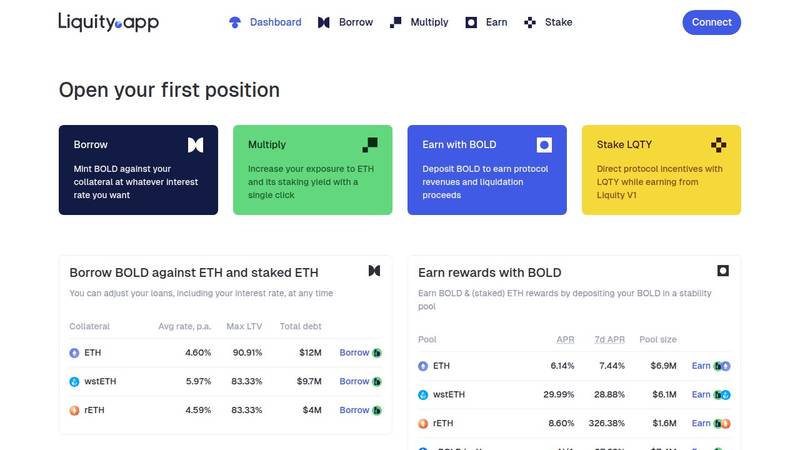
A second table lists stability pools. ETH showed a 6.45% APR and an 8.29% seven day APR with a $6.6 million pool. wstETH showed 8.36% and 32.96% with $6 million. rETH showed 8.21% and a seven day figure of 326.45% with $1.7 million. A third table lists outside yield sources such as Yearn yBOLD at 48.29% and a Uniswap v4 BOLD and USDC pool at 40.61%. Those are third party products and we did not test them.
Connecting a wallet
The connect window listed MetaMask, Coinbase Wallet and WalletConnect, and a link for people who do not have a wallet. We picked MetaMask. MetaMask opened a window that said this site would see addresses, balances and activity and could send requests for transactions, and that it could not move funds without approval. We approved only that connection. The button then showed the shortened address.
One practical note. The connection did not carry across our separate test runs, so we connected again each time. That is a function of how our test browser was set up and not a finding about the app.
Borrow
The Borrow page reads “Borrow BOLD with ETH”. A collateral box sits at the top with a token picker, so you can switch between ETH, wstETH and rETH. Under it is a Loan box in BOLD. Below that the page shows a BOLD creation fee, a liquidation price and a liquidation risk label, plus your LTV.
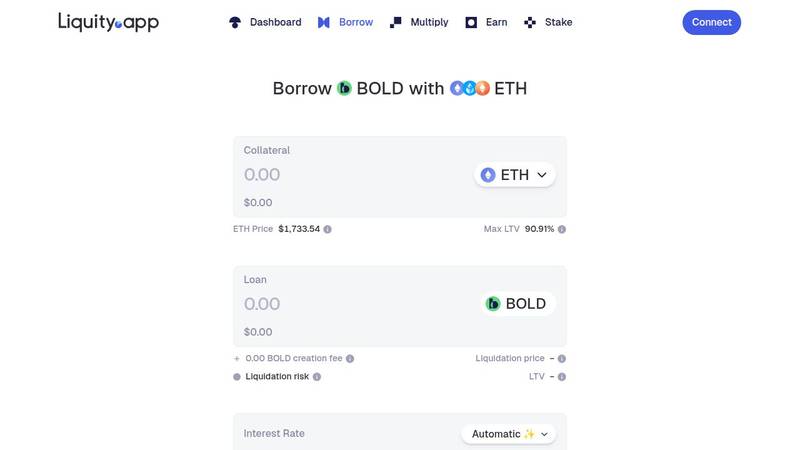
When we typed 1 into the collateral box, the box priced it at $1,696.49, the ETH price the app was using. The loan box stayed at zero because we did not choose a loan size. LTV showed 0.00% and the liquidation risk showed N/A, which is correct for a loan of zero.
The interest rate section is the part that makes Liquity different. It has a mode switch that was set to Automatic, with a slider from Balanced to Conservative and Aggressive in the middle. We saw a line saying a managed strategy for ETH collateral “aims to pay the lowest rate while attempting to avoid redemptions”, an annual fee of 0.3% for that service, a rate of 4.50% and a note that 2.8 million BOLD sat ahead of us in the redemption queue. The page labelled that a medium redemption risk. A short explainer on redemptions sits right under it, which is a good touch for a beginner.
Our reading is that the Automatic option is for people who do not want to watch their own rate, and the manual option is for people who do. The Automatic option has a cost, the 0.3% fee, and it puts a third party in charge of your rate, so you should read what that third party does before you use it. We did not test the manual rate slider with a real loan.
Multiply
The Multiply page is the leverage page. It says “Multiply your exposure to” ETH, with a deposit box, a liquidation price slider and a multiplier. The default was 1.5x with an LTV of 33.33% and a label of low liquidation risk. At 1.5x the liquidation price read $622.04 against an ETH price of $1,696.49. The page also showed fields for price impact, exposure and a slippage refund, which were empty until an amount is entered.
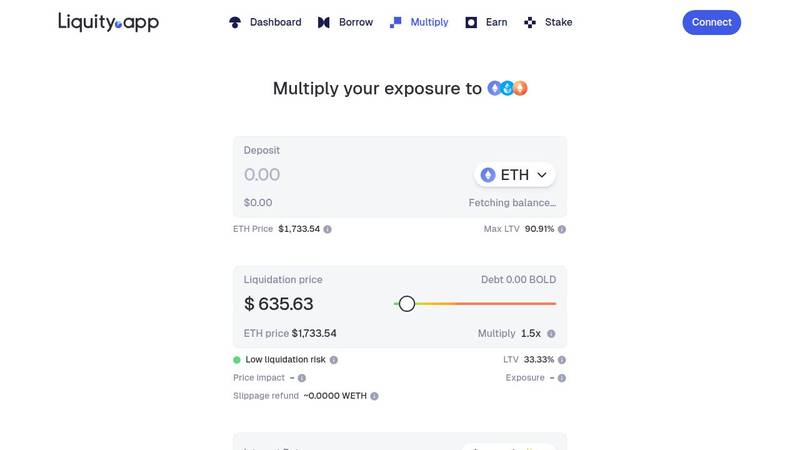
Here is what leverage means in this setting. You deposit ETH. The page borrows BOLD, swaps the BOLD to more ETH and deposits that too. You end up holding more ETH than you put in, with a BOLD debt behind it. If ETH goes up, you gain more than a plain holder. If ETH goes down, you lose more, and the liquidation price tells you where the loan gets sold. The docs add that there are extra costs for this: a BOLD creation fee when you raise exposure and swap fees when BOLD is exchanged for ETH.
We could not enter a real amount because the demo wallet was empty, and the box capped at “Max 0.00 ETH”.
Earn
The Earn page lists the stability pools. Each pool row shows its size, its APR and its seven day APR. Opening the ETH pool showed TVL of $6.6 million, APR 6.4% and seven day APR 8.3%. A panel has tabs for Deposit, Rewards and Update, buttons for claim rewards, compound, increase deposit and withdraw, and a pool share of 0% because we had nothing in it.
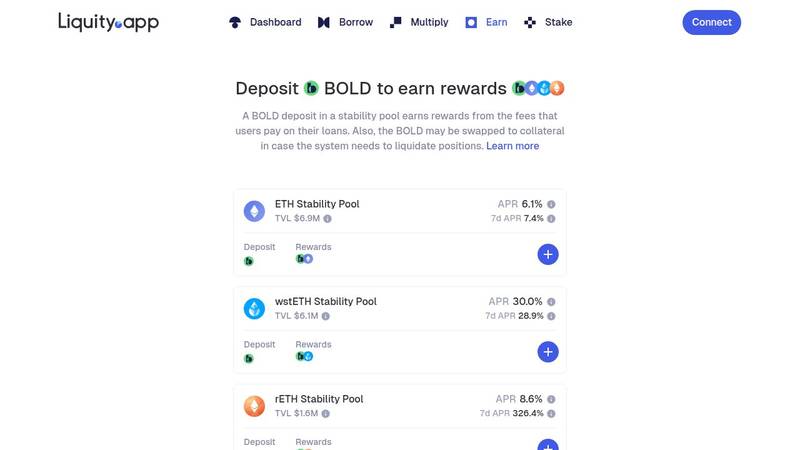
The page explains that a BOLD deposit “earns rewards from the fees that users pay on their loans” and that the BOLD may be swapped to collateral when the system needs to liquidate positions. That second part is the risk. A depositor is not just earning a rate. A depositor is the buyer of last resort for bad loans.
Stake
The Stake page is for LQTY, the Liquity token. It says that staking gives voting power over where incentives go in version 2, while still earning version 1 fees. The page showed a Staked amount, Rewards, Voting share and Allocated, all zero for us, with tabs for Staking, Rewards and Voting. We could not stake because we hold no LQTY.
What It Costs to Use Liquity
We could only read the costs, not pay them. Here is the full list from the docs and the app. There is an upfront borrowing fee of about seven days of average interest on the branch, charged when a loan opens. There is the interest itself, at the rate you pick, which is added to your debt over time. There is a BOLD creation fee on the Multiply page when you raise exposure. There are swap fees when BOLD is exchanged for ETH inside Multiply. The Automatic rate option adds an annual fee of 0.3% on the managed amount. Finally, a refundable gas deposit of 0.0375 WETH is held when a loan opens and returned when it closes, and liquidators take a small extra slice from the collateral of a liquidated loan. Ethereum network fees apply to every action and we could not price them without a funded wallet.
The practical point is that closing and reopening a loan often is expensive on purpose, because the upfront fee punishes it. Pick a rate you can live with and avoid changing it every week.
Redemptions Explained With a Short Story
Redemptions are the least known part of Liquity, and they matter most to a borrower. Suppose BOLD trades at 98 cents on the market. A trader can buy BOLD at 98 cents and hand it to the protocol, which treats it as worth one dollar and pays out a dollar of ETH. The trader keeps the two cents. That buying pressure pushes BOLD back toward a dollar, which is the goal.
Where does the ETH come from? From the loans paying the lowest rates. If your loan is first in line, part of your debt is wiped and part of your ETH is taken, in equal dollar amounts. In practice you now hold less ETH than you planned, and you may have to open a new loan. A borrower who wanted to keep a long term ETH position can find that annoying. This is why the page shows how much BOLD sits ahead of you, 2.8 million in our test, and why it rates your redemption risk. Raising your rate moves you back in the line.
Who Should and Should Not Use Liquity
Liquity suits a person who holds ETH or a staked version, wants a dollar coin without selling, and is comfortable checking a loan every few days. It also suits someone who values code that cannot be changed and does not want a committee changing the rules. A depositor in the Earn pools can also fit, if they accept that they are the buyer of last resort for bad loans.
It is a poor fit for a first time crypto user who has never taken a loan. It is a poor fit for anyone who needs a fixed rate, who cannot watch prices, or who is not ready to verify the address of a third party front end. The 2025 bug, the active Safety Mode banner and the small market are further reasons to start with a small amount.
A Worked Example: A Loan in Plain Numbers
This is an illustration with round numbers. It uses the ETH price the app showed, $1,696.49, and the rules in the docs. We did not open this loan, because the demo wallet was empty.
Say you deposit 10 ETH, worth $16,964.90. You borrow 8,000 BOLD, which is above the 2,000 minimum. Your LTV is 8,000 divided by 16,964.90, about 47.2%. The ETH branch lists a max LTV of 90.91%, and on the Multiply page the liquidation price matched that limit, so we treat it as the point where the loan is sold. The price where 8,000 BOLD hits 90.91% of 10 ETH is about $880. That is a fall of roughly 48% from $1,696.49.
Now the costs. If you choose a 5% rate, the docs say a loan of 10,000 BOLD at 5% costs about 500 BOLD a year, added to your debt. Your 8,000 BOLD would cost about 400 BOLD a year. If you are liquidated, a penalty of usually 5% applies and you can claim the remaining collateral.
Two cautions. First, a low rate can bring a redemption. If BOLD trades under one dollar and your rate is among the lowest, a redeemer can swap BOLD for part of your ETH at face value. The docs describe this as a swap at a dollar per BOLD and not a loss in value, but it can force a taxable sale or change your position. Second, if the ETH branch is in Safety Mode, as it was in our test, some actions are not allowed, including adjusting a rate early. Plan for that before you borrow.
The LQTY Token
LQTY is the governance and incentive token. Holders can stake it, earn version 1 fees and direct version 2 incentives. CoinGecko showed the following on November 26, 2026.
| Item | Value |
|---|---|
| Price | $0.132981 |
| Market cap | $13.15 million |
| Fully diluted value | $13.30 million |
| Circulating supply | 98.92 million of 100 million |
| All time high | $146.94 on April 5, 2021 |
| All time low | $0.122481 on November 21, 2026 |
| 24 hour change | plus 1.4% |
| 7 day change | minus 4.0% |
| 30 day change | minus 31.4% |
| 1 year change | minus 69.1% |
| Rank | about 949 |
| 24 hour volume | about $1.48 million |
The other side is that the price is about 99.9% below its 2021 peak and set a new low five days before our check. You do not need LQTY to borrow BOLD, and holding it is a bet on the protocol, not a requirement for using it. We do not offer a view on whether to buy it.
Risks, Audits and Incident History
| Risk | What it means | What we saw |
|---|---|---|
| Smart contract risk | Immutable code cannot be patched, so a bug stays | A bug was found in version 2, see below |
| Liquidation | If LTV hits the limit, the loan is sold with a usual 5% penalty | Max LTV 90.91% for ETH, 83.33% for the others |
| Redemption | Low rate loans are redeemed first when BOLD is under $1 | App showed a medium redemption risk at 4.50% |
| Safety Mode | Restricts actions that lower a branch’s collateral ratio | Active on the ETH branch during our test |
| Shutdown | A branch can be shut down if its collateral ratio falls under 110% (ETH) or 120% (others) | Not active |
| Front end risk | The site you use is run by a third party | Four independent operators, no official app |
| Stability pool loss | Depositors take on bad loans for collateral | Pool APRs swing widely |
| Market risk | ETH can fall fast | ETH was $1,696.49 on the app |
Safety Mode. The docs say it starts when a branch’s total collateral ratio falls under a critical level, 150% for ETH and 160% for wstETH and rETH. It restricts actions that would lower that ratio further, but it does not put loans at risk of liquidation, which is how the old Recovery Mode in version 1 behaved. The banner was on during our visit. We could not tell from the page how long it had been on or what had triggered it, and we did not verify the branch ratio on chain.
The 2025 stability pool bug. On February 12 and 13, 2025 the team reported an issue in the stability pools of the first version 2 deployment and told users to close their Earn positions. To the team’s knowledge, no user was affected. Borrow, Multiply and Stake were not hit, and BOLD stayed backed and redeemable. The team redeployed after a five week audit contest with more than 800 researchers on Cantina and re-audits by ChainSecurity and Dedaub. Version 2 went live again on May 19, 2025. A team that finds a bug, tells users to leave and then redeploys after more review is acting responsibly. The fact remains that a serious bug lived in code that had already been audited, and this is the central lesson about audits.
Audits. The docs list several ChainSecurity assessments between August 2024 and May 2025, two Dedaub reports from August and November 2024 and a Coinspect audit from December 2024. We did not open the reports. A bug bounty runs on Cantina. DefiLlama’s hacks list showed no Liquity entry when we searched.
Code. The main repo, liquity/bold, had 140 stars and 145 forks and was last pushed on September 26, 2026. GitHub listed its license as NOASSERTION, which means it did not detect a standard one, so check the file before you copy anything.
DefiLlama showed about $60.0 million locked in version 2 and $120.3 million in version 1. Stablecoin data showed about 26.8 million BOLD in circulation and a price of $1.0015.
How Liquity Compares
This is a design comparison from public information. We did not test the others for this review.
| Protocol | How it differs |
|---|---|
| Aave | Variable rates set by an algorithm, many assets, upgradeable by governance |
| Sky (formerly Maker) | A stability fee set by governance and many collateral types |
| Curve crvUSD | A different liquidation model that sells collateral gradually |
Liquity’s difference is that no one sets your rate and no one can change the code. The price of that is fewer assets, a smaller market and no ability to fix a mistake after the fact.
What We Verified and What We Did Not
| Item | Status |
|---|---|
| Dashboard, Borrow, Multiply, Earn, Stake pages on desktop | Verified |
| Wallet connection with MetaMask | Verified, connection only |
| Collateral amount preview on Borrow | Verified |
| Rates, pools and TVL on the dashboard | Verified as displayed |
| Opening a loan, depositing in Earn or staking LQTY | Not verified. Demo wallet was empty and we signed nothing |
| Manual interest rate mode and the Automatic strategy in action | Not verified |
| Multiply with a real deposit | Not verified |
| DeFi Saver, LQTY.IO and Trove Zero front ends | Not tested |
| Audit report contents | Not verified |
| TVL, token and GitHub figures | Taken from DefiLlama, CoinGecko and GitHub on November 26, 2026 |
FAQ
Is Liquity safe?
It has several audits, a bounty and a clear design. It also had a serious bug in 2025, runs through third party front ends and carries liquidation risk. Use only money you can lose.
Does Liquity have an official website to borrow on?
No. Liquity AG says it does not run a front end. liquity.org lists four independent ones. Check the address you are on before connecting a wallet.
What is BOLD?
A coin built to be worth one US dollar, issued when you borrow against ETH, wstETH or rETH.
Can I set my own interest rate?
Yes in version 2. A lower rate costs less but puts you earlier in line for redemption.
What is the minimum loan?
2,000 BOLD, according to the docs.
What does Safety Mode mean for me?
Some actions are blocked, such as changing a rate early, until the branch recovers. It does not by itself liquidate your loan.
Do I need LQTY to borrow?
No.
Can I use MetaMask?
Yes. The app listed MetaMask, Coinbase Wallet and WalletConnect, and MetaMask connected in our test.
Quick Links
- Liquity home: https://www.liquity.org
- Front end list: https://www.liquity.org/frontend-v2
- Liquity.app: https://liquity.app
- Docs: https://docs.liquity.org
- Audits: https://docs.liquity.org/v2-documentation/technical-docs-and-audits
- Bug bounty: https://docs.liquity.org/v2-documentation/bug-bounty
- GitHub: https://github.com/liquity/bold
- DefiLlama: https://defillama.com/protocol/liquity-v2
- CoinGecko: https://www.coingecko.com/en/coins/liquity
This is an independent editorial review written on November 26, 2026. We have no commercial relationship with Liquity. It is not financial advice. DeFi lending can lose money, and rates, prices and features change quickly. Check every figure on the live app before you act.