




















Key Takeaways
- Hyperliquid is best understood as a high-speed on-chain order-book exchange, not a typical AMM-style perp DEX.
- Its strongest edge is CEX-like execution with self-custody, gas-free HyperCore trading, deep liquidity, and advanced order control.
- The main trade-off is a different risk stack: bridge, oracle, L1 maturity, liquidation, and leverage risks still require disciplined position sizing.

Most perp DEX reviews start with a broad definition of decentralized derivatives. That misses the real question. The reason traders talk about Hyperliquid is not only that it is on-chain, but that it makes self-custody feel less like a UX penalty. It combines a central limit order book, fast confirmation, USDC-margin perps, and a trading screen that looks familiar to anyone who has used Binance, Bybit, OKX, or dYdX.
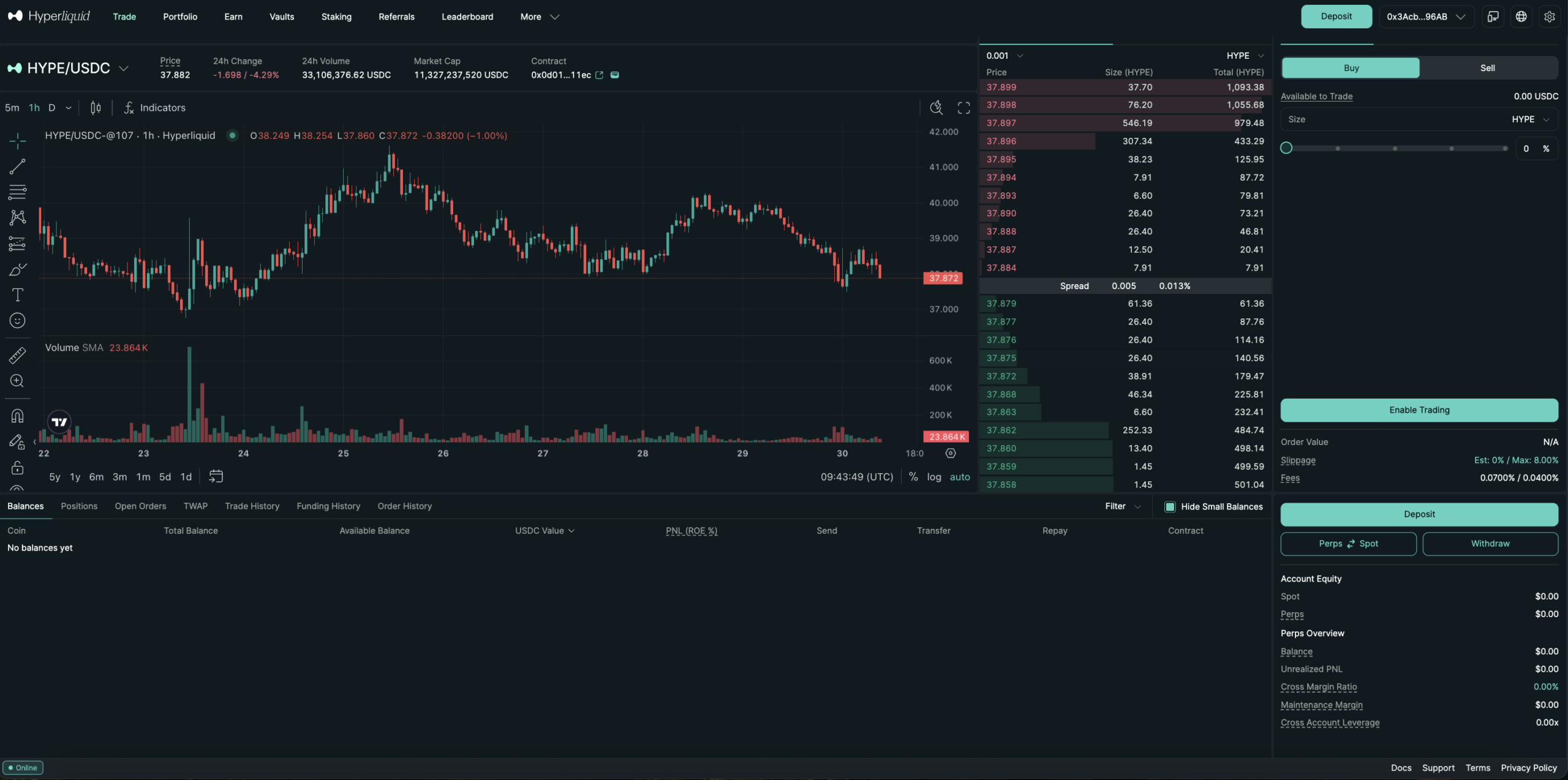
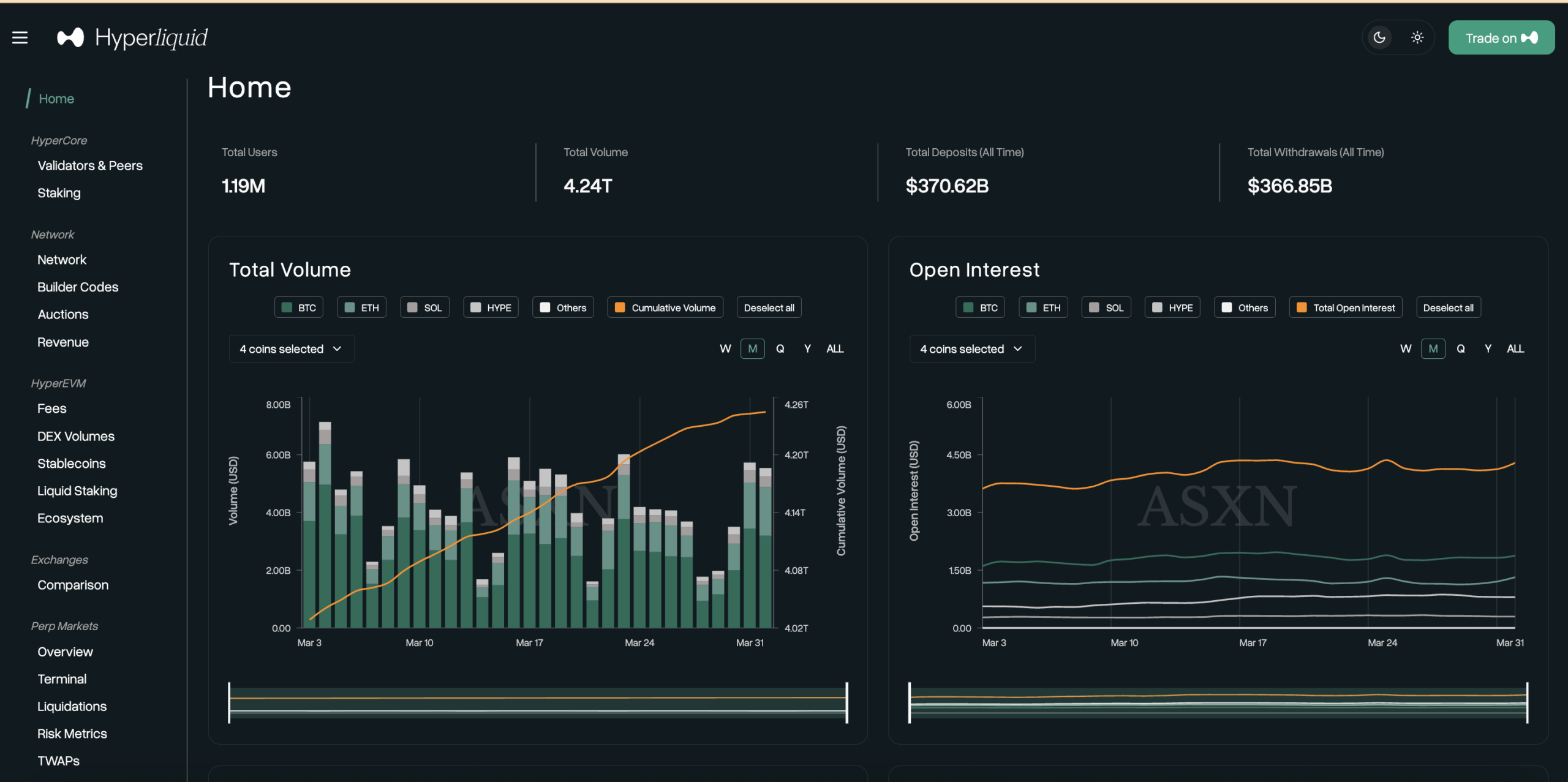
The market data now supports that product story. Public trackers show Hyperliquid among the largest perp DEX venues by 30-day volume and open interest, while the official HyperCore overview describes the chain as a trading-specific system rather than a general-purpose blockchain with a trading app bolted on top.
| Metric | Latest figure | Why it matters | Source |
| 30-day perp volume | About $195.0B | Confirms meaningful order-book demand beyond a niche DeFi venue. | DefiLlama |
| 24-hour perp volume | About $6.5B | Shows that liquidity is active daily, not only during one-off campaigns. | DefiLlama |
| Open interest | About $7.85B | Useful proxy for committed leverage and trader retention. | DefiLlama |
| Cumulative perp volume | About $4.4T | Signals that the product has reached exchange-scale usage. | Datawallet / market trackers |
| HyperCore throughput | About 200,000 orders/sec | Explains why the UI can feel closer to a CEX than a typical DeFi app. | Hyperliquid Docs |
| Latency | 0.2s median; 0.9s p99 | Important for active traders, market makers, and API strategies. | Hyperliquid Docs |
| Base perp fees | 0.045% taker / 0.015% maker | Competitive for active traders, with lower tiers at higher volume. | Hyperliquid Docs |
Public dashboards move quickly, so the table below should be read as a research snapshot for May 18, 2026, not a permanent benchmark.
Table of Contents
What Is Hyperliquid?
Hyperliquid is a purpose-built Layer 1 for trading. Its state is split between HyperCore, where margin, matching, liquidation, spot, and perp order-book activity live, and HyperEVM, the smart-contract environment that allows the ecosystem to expand beyond the exchange interface.
That split matters because Hyperliquid is not just another frontend routing orders into a slower settlement layer. The core exchange logic runs directly inside the chain’s execution environment, secured by HyperBFT consensus. In practice, this is why Hyperliquid can support active order placement, fast cancels, and API-driven strategies without requiring a gas payment for every order edit.
How Hyperliquid Differs From Typical Perp DEXs
Many perp DEXs are built around AMMs, virtual liquidity, oracle pricing, or hybrid off-chain order books. Hyperliquid goes in the opposite direction: it uses an on-chain order book with price-time priority. A maker adds liquidity. A taker crosses the spread. The trading behavior is easy to understand because it mirrors exchange mechanics that professional traders already know.
The difference is not cosmetic. AMM-based perps can be elegant for passive liquidity, but they often hide execution inside spread, impact, and pool-risk assumptions. Hyperliquid exposes the book, making liquidity depth, spread, resting bids, and asks part of the trader’s decision.
Trading Infrastructure and Order Book Design
The core design is a CLOB, not a swap pool. Orders must respect tick size and lot-size rules. Matching follows price-time priority. The fee schedule uses rolling 14-day volume, with the base perp tier currently listed at 0.045% taker and 0.015% maker. Maker rebates and staking-linked discounts can change the effective rate for high-volume users.
This creates a cleaner execution model for scalpers, discretionary traders, and market makers. If you want immediate execution, you pay the taker rate. If you can wait, you can place a post-only limit order and avoid crossing the spread.
Execution Speed and Trading Environment
Speed is the product’s clearest edge. Hyperliquid documentation cites about 200,000 orders per second of current mainnet capacity, plus roughly 0.2-second median latency for geographically co-located clients. Those numbers are why Hyperliquid is usually judged against CEXs, not only against other DeFi venues.
For normal users, the impact is simple: the UI responds quickly, cancels do not feel like a slow blockchain transaction, and the trading loop feels continuous. For API users, the same infrastructure makes order refresh, market making, and hedging strategies more realistic than on slower chains.
Trading Workflow Walkthrough
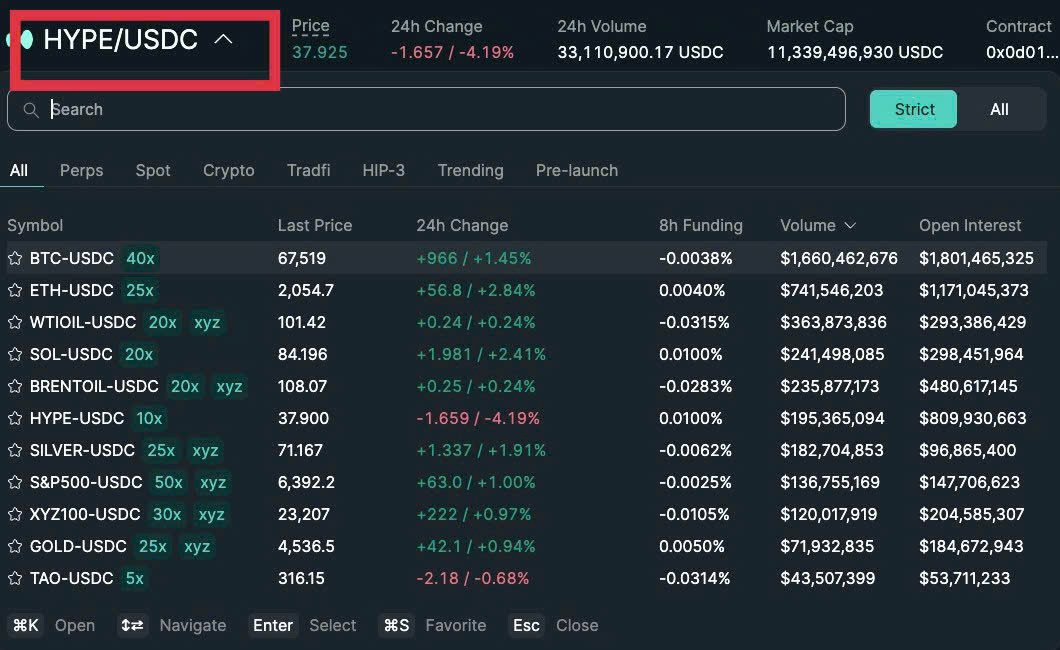
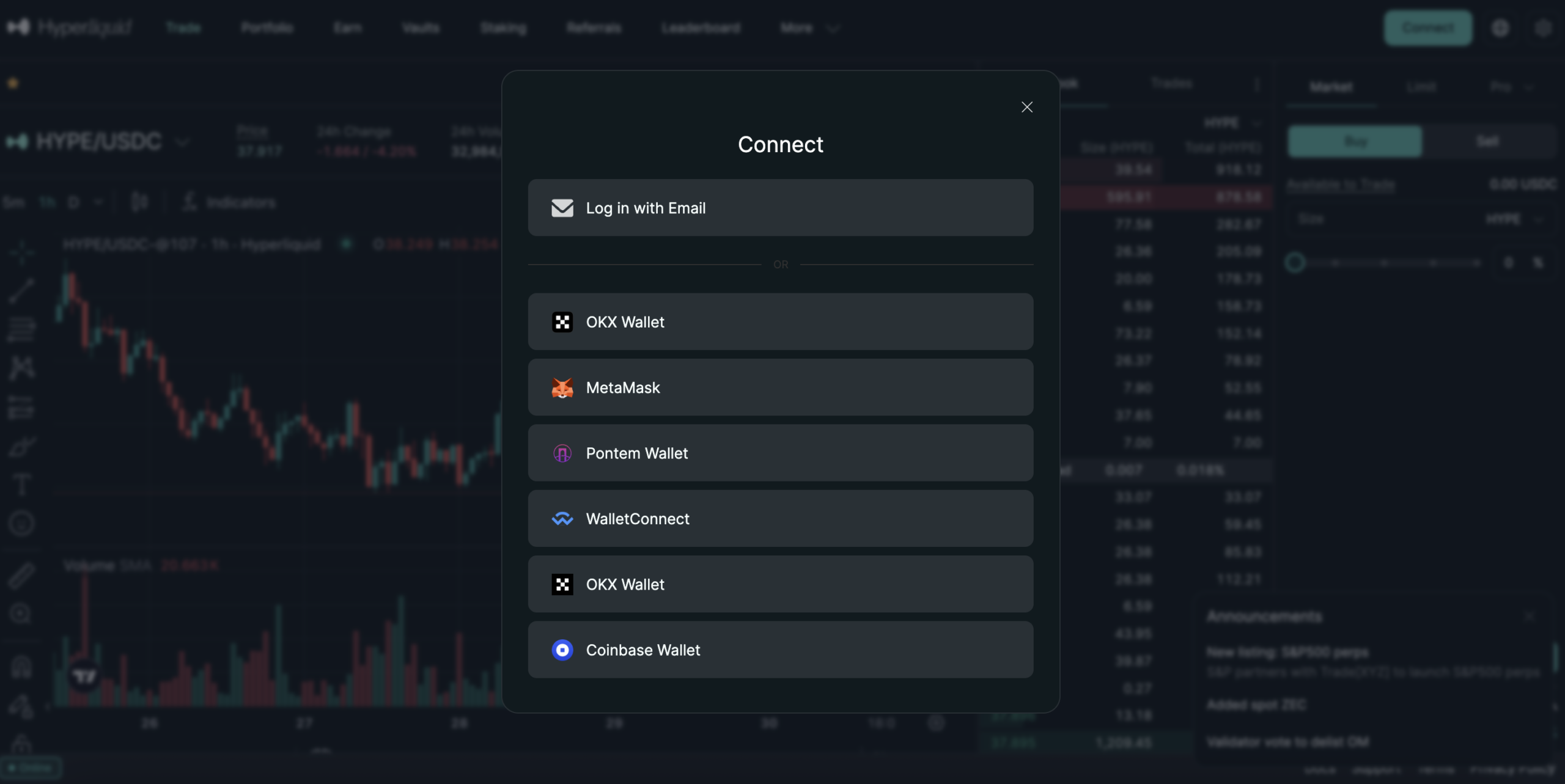
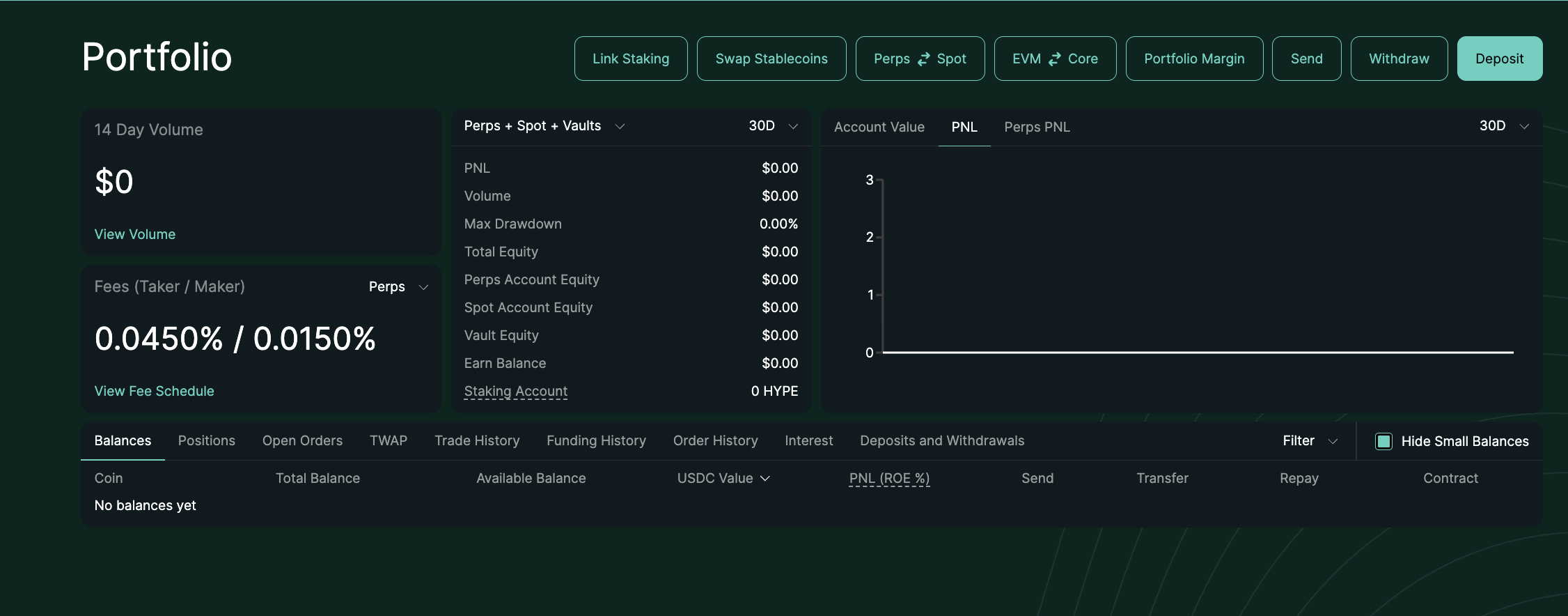
A practical workflow begins with connecting a wallet, depositing collateral, selecting a market, and deciding between cross and isolated margin. The supplied file already shows the basic flow: wallet connection, USDC deposit, pair search, trading screen, portfolio view, Earn, vaults, staking, referrals, leaderboard, sub-accounts, funding comparison, stats, and docs.
The most important beginner habit is to separate entry logic from risk logic. Entry can be a market or limit order. Risk should use reduce-only exits, stop-loss triggers, and position sizing that does not make liquidation the default exit plan.
My Experience Using Hyperliquid as a Trader
Hyperliquid’s best quality is that it does not ask active traders to relearn execution. The trading screen gives quick access to the book, chart, order form, positions, and account state. The result is not a DeFi app that happens to offer perps; it feels like a trading venue first.
The most useful detail is the pace of position management. Adjusting orders, checking margin, reviewing PnL, and moving between market search, portfolio, vaults, and stats all fit into the same trading loop. That matters because serious perp traders do not only need a place to enter; they need a venue where monitoring and exit decisions stay visible.
The weak point is the same feature that makes it attractive: leverage is too easy to deploy. Fast execution, visible liquidity, and low friction can encourage oversizing. The platform gives traders serious tools, but it does not protect them from poor discipline, bad funding assumptions, or a fast liquidation cascade.
Fees, Funding, and Capital Efficiency
Fees are only one side of trading cost. The other is funding. Hyperliquid’s funding states that funding is peer-to-peer, paid hourly, and designed to keep perpetual prices close to spot oracle prices. Longs pay shorts when the perp trades above the oracle; shorts pay longs when it trades below.
Capital efficiency is strong because collateral, margin, sub-accounts, and multiple positions can be managed inside one venue. That is useful for active traders, but it also means cross-margin mistakes can spread risk across positions. New traders should start with isolated margin until they understand liquidation behavior.
Advanced Trading Features
Hyperliquid supports market, limit, stop market, stop limit, take market, take limit, scale, and TWAP orders. The official order-type describe TWAP as splitting a larger order into 30-second suborders with slippage constraints. That is useful when entering or exiting size without advertising the full order at once.
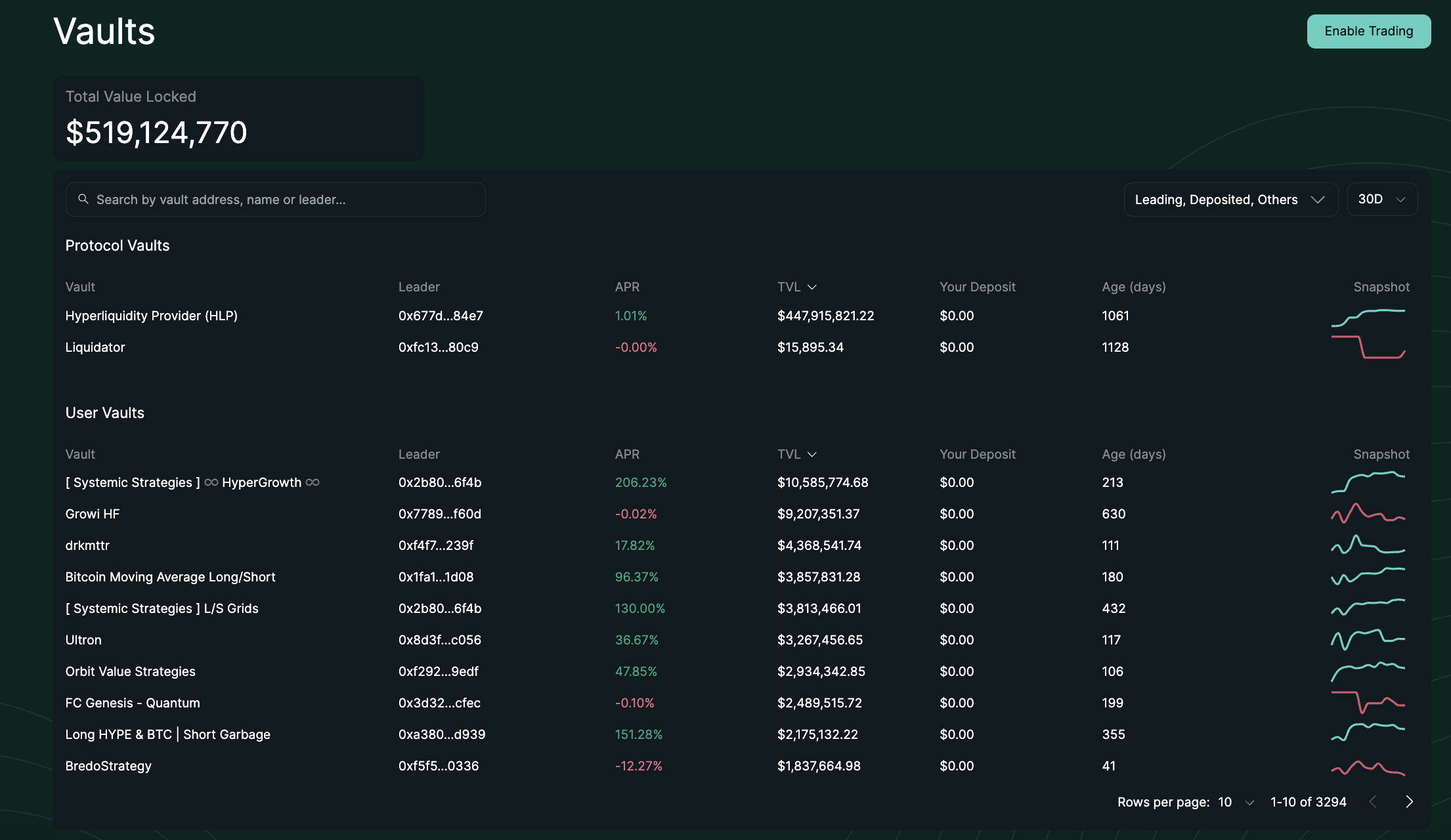
Other features broaden the product: sub-accounts help separate strategies, vaults allow users to allocate to automated strategies, staking delegates HYPE to validators, and the API allows bot or copy-trading integrations. The supplied screenshots of Earn, Vaults, Staking, Referrals, and API are useful because they show that Hyperliquid is now more than a single perp screen.
Strengths and Trade-Offs
| Area | Where Hyperliquid is strong | What traders should still watch |
| Execution | Fast finality, familiar CLOB interface, no HyperCore gas for order updates. | Latency still depends on connectivity, volatility, and market depth. |
| Liquidity | Majors usually feel deep enough for active trading. | Long-tail assets and HIP-3 markets can widen sharply. |
| Self-custody | Funds remain wallet-connected rather than held by a centralized exchange. | Bridge, wallet, API key, and signing risks remain user responsibilities. |
| Features | TWAP, scale orders, TP/SL, reduce-only, sub-accounts, vaults, staking, referrals. | More tools increase complexity for beginners. |
| Ecosystem | HyperEVM and HIP-3 turn Hyperliquid into a broader execution layer. | New markets add oracle, governance, and regulatory uncertainty. |
Security and System Risks
Hyperliquid is self-custodial, but self-custody does not erase protocol risk. The official risk page highlights smart contract risk, L1 risk, market liquidity risk, and oracle manipulation risk. The audit page also notes Zellic audits for the bridge contract.
The main trader takeaway is practical: treat Hyperliquid like a high-performance venue, not a guaranteed-safe savings account. Keep only needed collateral on-platform, rotate API keys carefully, avoid signing unknown transactions, and respect oracle risk on less liquid markets.
Who Hyperliquid Is Designed For
- Active crypto traders who understand perps, funding, liquidation, and order-book execution.
- Market makers and API users who need fast order updates and transparent fills.
- DeFi-native users who want self-custody without accepting AMM-style perp execution.
- Builders creating frontends, vaults, analytics, or HIP-3 markets around HyperCore liquidity.
- Traders who want an on-chain venue that can seriously compete with centralized exchanges.
Is Hyperliquid a CEX Alternative?
For crypto-native derivatives traders, yes, with caveats. Hyperliquid is credible as a CEX alternative because the order book, latency profile, fee structure, and product density are close enough to centralized venues for many active strategies.
But it is not a perfect replacement for every user. CEXs still have fiat rails, account recovery, compliance infrastructure, tax exports, support teams, and broad spot liquidity. Hyperliquid’s advantage is different: transparent execution, wallet-based access, programmable expansion, and a trading-specific chain.
The most important long-term development is HIP-3. The official HIP-3 docs describe permissionless builder-deployed perps, where deployers define markets, oracle logic, contract specifications, and leverage limits. That can turn Hyperliquid from a perp DEX into an execution base layer for many market operators.
Conclusion
Hyperliquid is one of the few on-chain trading products that should be evaluated against centralized exchanges rather than only against DeFi peers. Its strongest attributes are speed, depth, order control, gas-free trading, API access, vaults, staking, builder markets, and on-chain transparency.
The trade-off is that traders inherit a different risk stack: bridge exposure, L1 maturity, validator/oracle assumptions, liquidation design, and market-specific liquidity. For experienced traders, that trade-off can be attractive. For beginners, Hyperliquid should be approached slowly, with small size and strict position rules.
FAQs
Is Hyperliquid decentralized?
It is an on-chain trading L1 with validator-based consensus and transparent order-book activity. Still, traders should evaluate validator, bridge, oracle, and governance assumptions rather than treating decentralization as binary.
Does Hyperliquid charge gas fees?
HyperCore trading does not require separate gas for each order placement or cancellation. Users still pay trading fees and may pay or receive funding.
What are Hyperliquid’s base perp fees?
The official fee schedule lists a base perp taker rate of 0.045% and a base maker rate of 0.015%, with discounts at higher rolling 14-day volume tiers.
What collateral does Hyperliquid use?
USDC remains the main collateral asset for a simple trading workflow, while the ecosystem has also expanded around USDH and HyperEVM assets.